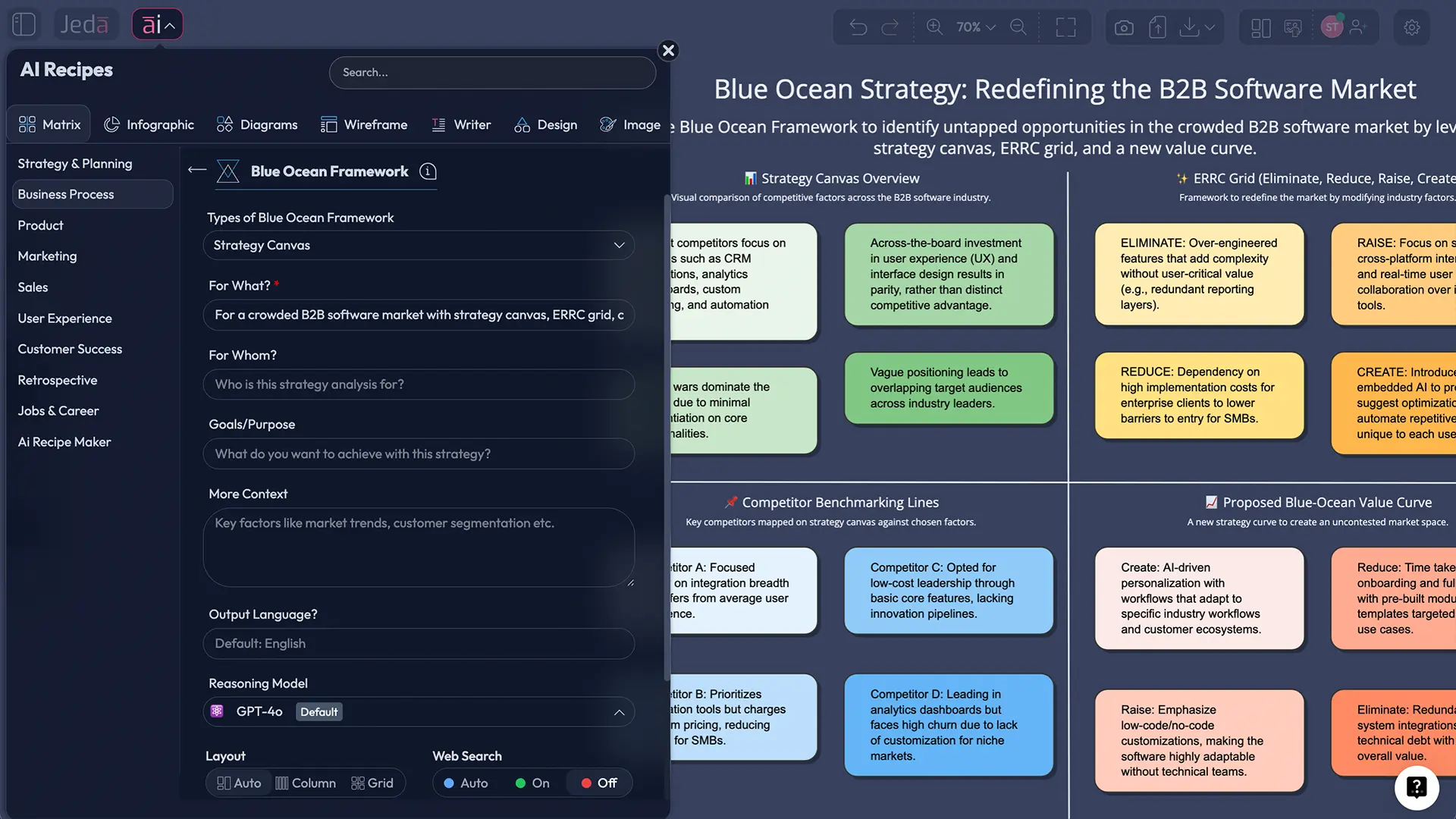
Blue Ocean Strategy template work usually dies in one of two ways. It becomes a classroom exercise no one uses, or it turns into a pretty chart that says nothing bold. Blue Ocean Strategy with AI changes that. Inside Jeda.ai, you can build the strategy canvas, pressure-test the value curve, and turn the whole thing into an editable AI Workspace instead of a dead slide. That matters when teams want speed, clarity, and an actual decision. It also explains why 150,000+ users keep using Jeda.ai as an AI Whiteboard for strategic work, not just sketching. Add the fact that Jeda.ai gives teams access to 300+ strategic frameworks, and the workflow starts to look a lot less like planning theater and a lot more like action.
What is Blue Ocean Strategy?
Blue Ocean Strategy is a market-creation framework developed by W. Chan Kim and Renée Mauborgne. The core idea is simple, but not simplistic: stop fighting for a slightly larger share of an overcrowded market and instead create uncontested demand by delivering a leap in value. The framework is built on value innovation, which means pursuing differentiation and low cost together rather than treating them as a tradeoff.
That is the part many teams miss.
They hear “blue ocean” and think it means “invent something wildly new.” Not necessarily. Sometimes the move is a new customer segment. Sometimes it is a re-cut offer. Sometimes it is a smarter experience design. The point is not novelty for novelty’s sake. The point is to reconstruct the market in a way that makes old comparison rules weaker.
In practice, Blue Ocean Strategy becomes useful when you move from slogan to structure. That is where the framework tools come in: the Strategy Canvas, Four Actions Framework, ERRC Grid, the Six Paths Framework, and the Three Tiers of Noncustomers. If you want to pressure-test the competitive side first, pair this page with Porter’s Five Forces or broaden the external context with PESTEL analysis.
Why Blue Ocean Strategy still matters in crowded markets
Most markets are noisy, over-served, or weirdly imitative. Everyone claims to be customer-centric. Everyone adds more features. Everyone says “premium” or “AI-powered” and hopes that does the job. It usually does not.
Blue Ocean Strategy still matters because it forces a harder question: which parts of the industry’s logic should you stop respecting?
That shift is uncomfortable. Good. It should be.
A strong blue ocean move does not begin with “How do we beat Competitor X?” It begins with “Why is the category built this way, and which assumptions no longer deserve oxygen?” That is why the framework remains useful for strategy consultants, startup founders, product teams, and business leaders running planning sessions in an AI Workspace. It moves the conversation away from incremental rivalry and toward deliberate market design.
And when you use an AI Whiteboard instead of scattered notes, the conversation gets sharper. You can see the tradeoffs. You can compare value curves. You can challenge lazy assumptions in public. Very healthy for strategy. Slightly dangerous for weak ideas.
The Blue Ocean Strategy tools and sub-frameworks that actually matter
You do not need every Blue Ocean Strategy tool every time. But you do need to know what each one is good for.
Strategy Canvas
The Strategy Canvas is the visual backbone. It maps the factors an industry competes on and shows how different players invest across those factors. If your canvas looks nearly identical to competitors, congratulations, you are very likely stuck in a red ocean.
Use it to compare:
- your current offer
- major competitors
- adjacent alternatives
- a proposed blue ocean move
Four Actions Framework
This is the most operational part of the framework. It asks four questions:
- What should be eliminated?
- What should be reduced?
- What should be raised?
- What should be created?
That is how you stop talking in vague strategic poetry and start making design choices.
ERRC Grid
The ERRC Grid takes the Four Actions Framework and turns it into a working matrix. For Jeda.ai users, this is often the best entry point because it fits naturally inside a Matrix command flow. It is fast to review, easy to collaborate on, and brutally clear when a team is pretending to innovate while keeping everything the same.
Value Innovation
This is the principle under the hood. Blue Ocean Strategy is not about premium differentiation alone, and it is not about low-cost stripping either. It is about aligning utility, price, and cost so the offer creates a meaningful leap in value for buyers and for the business.
Six Paths Framework
This tool helps teams search beyond obvious industry boundaries. You can look across:
- alternative industries
- strategic groups
- buyer groups
- complementary offerings
- functional versus emotional appeal
- time and external trends
If the Strategy Canvas tells you the current picture, the Six Paths Framework helps you find exits from it.
Three Tiers of Noncustomers
This one matters more than teams expect. A lot of strategy work is trapped inside current-customer logic. The Three Tiers of Noncustomers pushes you to study:
- soon-to-be noncustomers
- refusing noncustomers
- unexplored noncustomers
That is often where demand creation begins.
Buyer Utility Map
The Buyer Utility Map is useful when a team has a clever concept but a fuzzy payoff. It forces you to clarify where the offer improves the buyer experience across stages and utility levers.
Sequence of Creating a Blue Ocean and Pioneer-Migrator-Settler Map
These are more advanced, but they help with feasibility and portfolio logic. The first checks commercial sequence. The second helps leaders see whether offerings are pioneers, migrators, or settlers. Useful when the room is full of ambition and thin on realism.
- Strategy Canvas
Shows how your offer differs from competitors across the factors that matter.
- ERRC Grid
Turns vague innovation talk into eliminate, reduce, raise, and create decisions.
- Value Innovation
Keeps teams focused on both buyer value and cost discipline.
- Six Paths Framework
Expands the search beyond direct rivals and tired industry assumptions.
- Noncustomers
Finds demand outside your current customer base instead of squeezing the same pool harder.
- Buyer Utility Map
Clarifies where the offer creates practical utility, not just new marketing language.
Why use Blue Ocean Strategy with AI?
Because the framework is strong, but the manual workflow is slow.
Teams usually gather research in one place, sketch the canvas somewhere else, argue in a meeting, rewrite notes in slides, then lose the thread. That is not strategy. That is administrative cardio.
Jeda.ai compresses that cycle. In one AI Workspace, teams can generate an initial Blue Ocean Strategy template, refine the matrix, compare alternative value curves, and extend the board without leaving the canvas. The output is editable. That matters. Static visuals are nice for screenshots, but strategy teams need live boards they can challenge and revise.
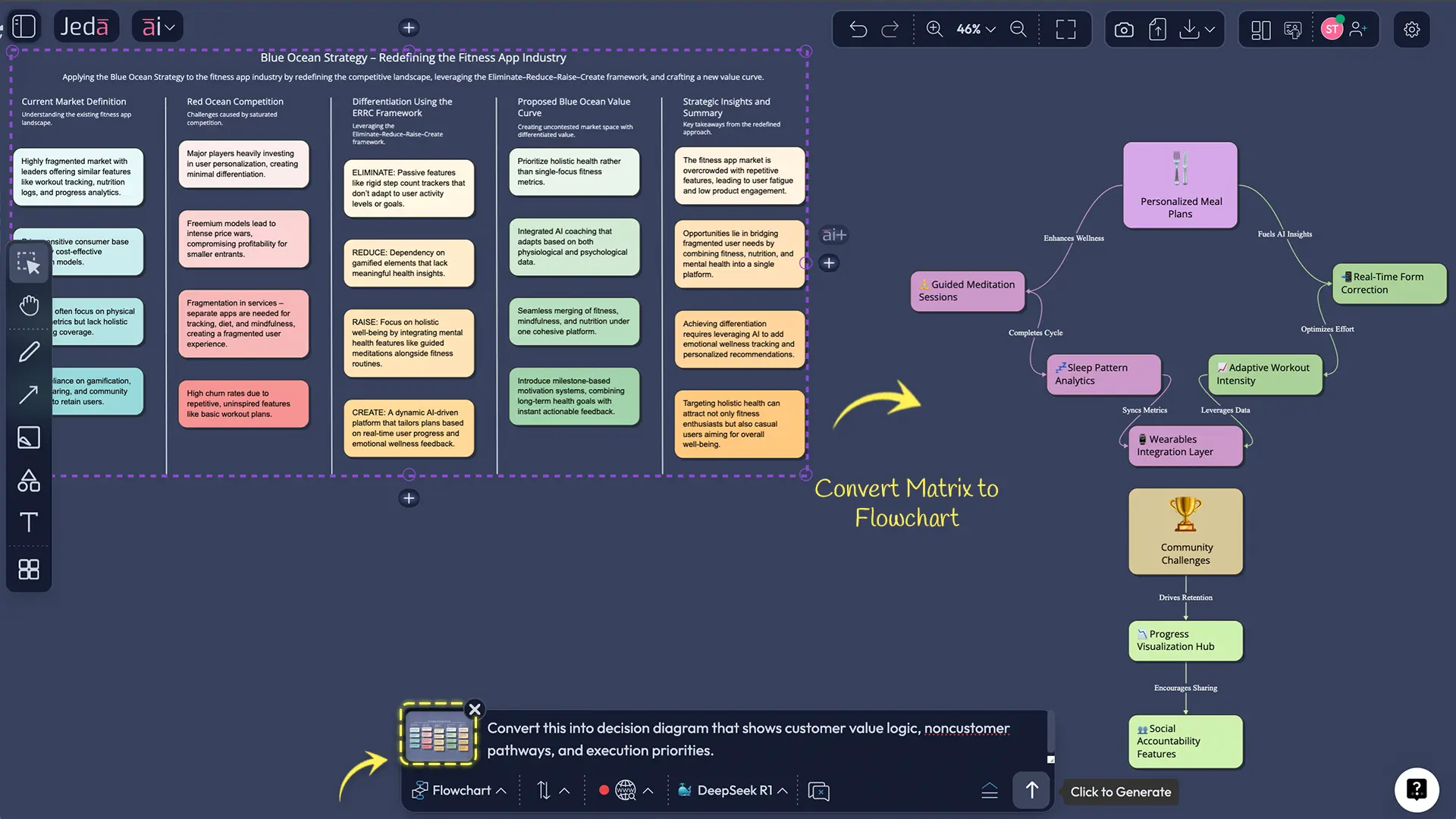
There is another gain here: range. Jeda.ai does not trap you inside one rigid template. You can start with the Blue Ocean Framework matrix recipe, deepen it with the Prompt Bar, then convert the result into a diagram with Vision Transform. That is where Visual AI becomes genuinely useful. The thinking stays connected while the format adapts.
And yes, speed counts. But speed alone is cheap. The bigger advantage is that the AI helps you explore more alternatives before the room settles too early on the first “good enough” idea.
How to create a Blue Ocean Strategy in Jeda.ai
Jeda.ai supports both the structured route and the flexible route. Use the first when you want guardrails. Use the second when your team already knows the market well and wants more freedom.
Method 1: Recipe Matrix
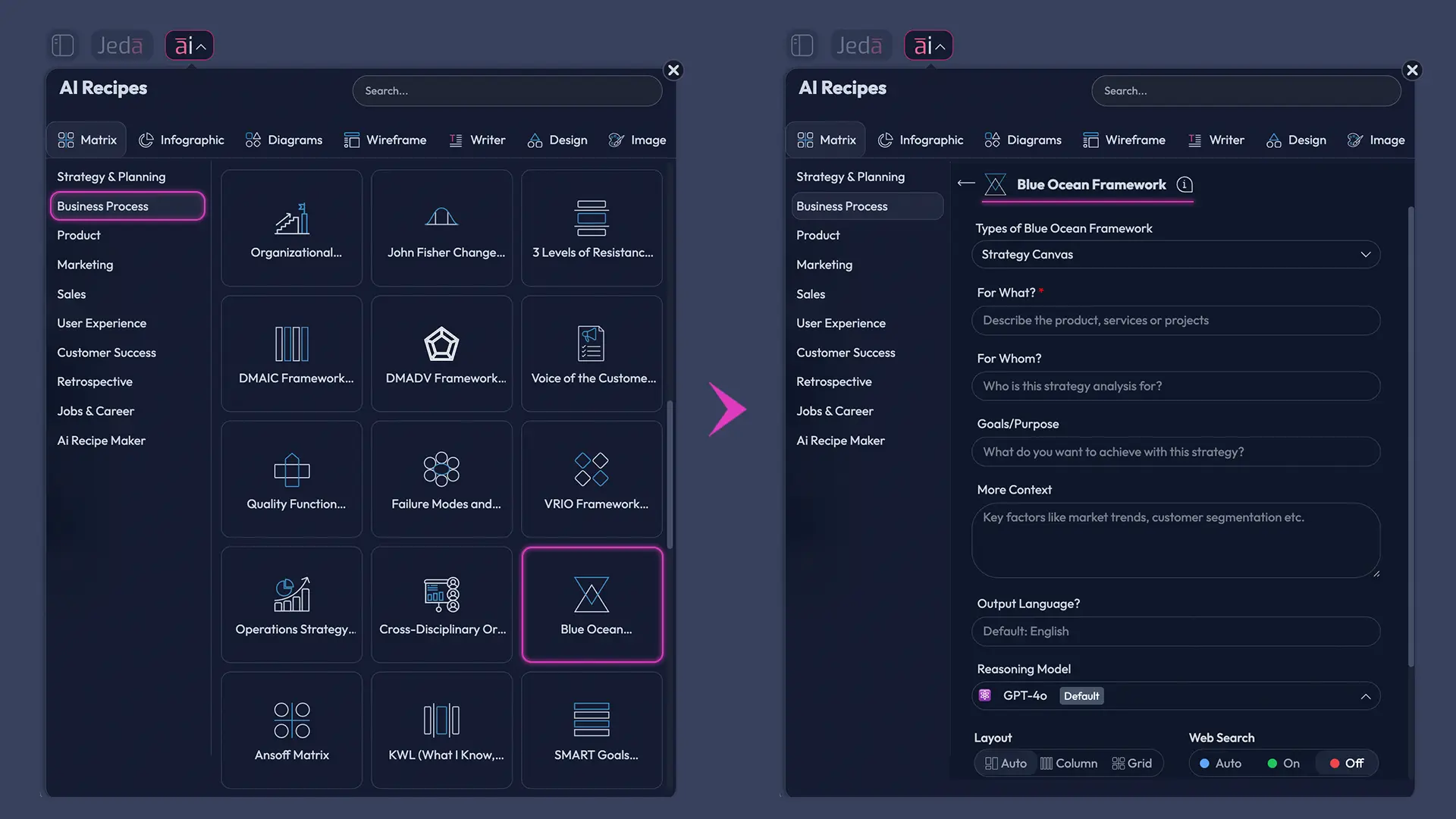
This is the recommended path because your topic already exists as the Blue Ocean Framework matrix template in Jeda.ai.
- Open AI Menu from the top-left of the canvas.
- Choose Matrix Recipes.
- Select Blue Ocean Framework.
- Add your context: industry, customer group, major competitors, buying criteria, and the outcome you want to create.
- Click Generate.
- Review the initial strategy canvas and ERRC-style recommendations with your team.
- Edit the board directly on the canvas.
This method is best for workshop speed, team alignment, and repeatability.
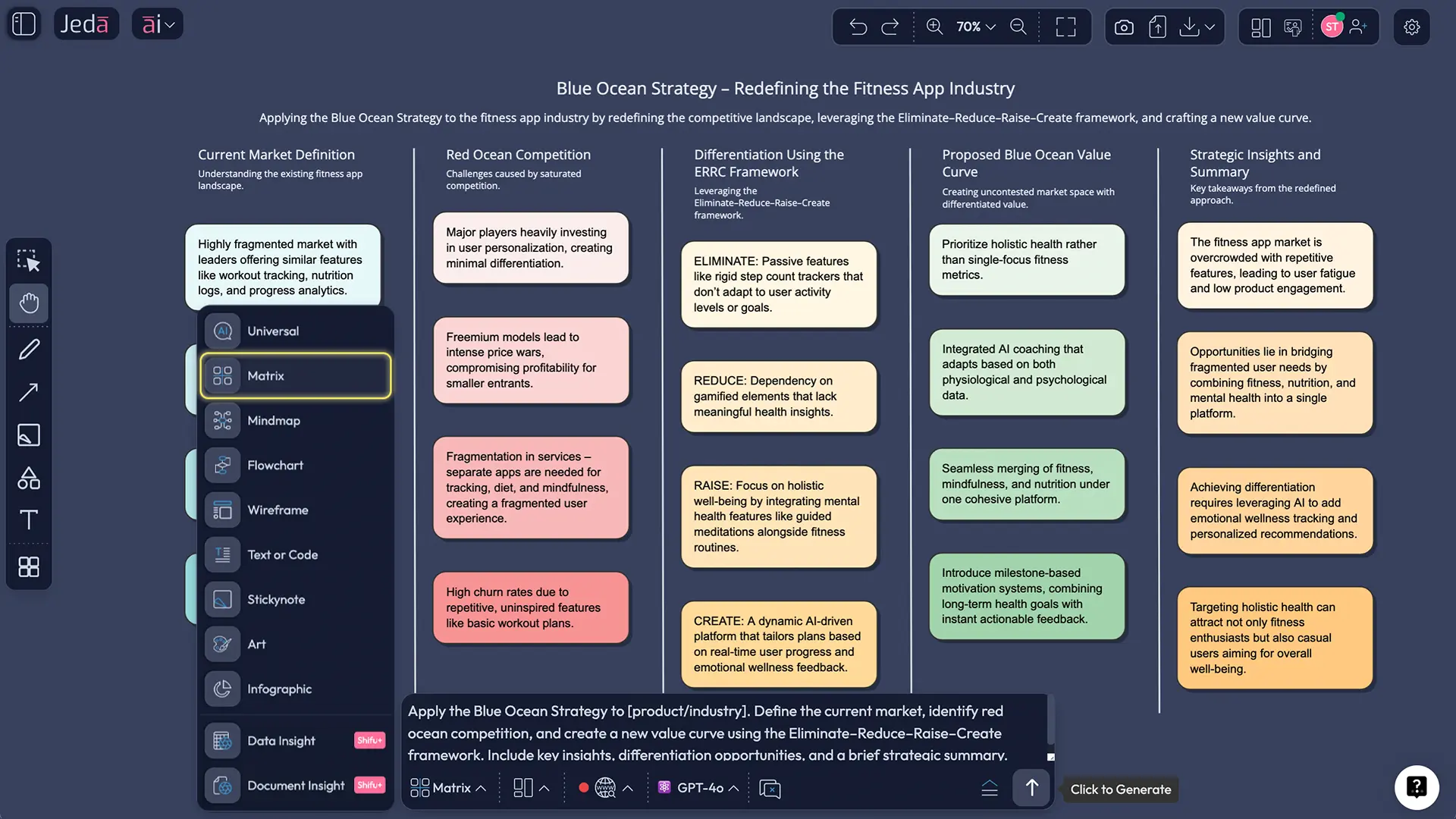
This method gives you more control and is ideal when you want the framework tuned to a specific market angle.
Open the Prompt Bar at the bottom of the canvas, select the Matrix command, and use a prompt like:
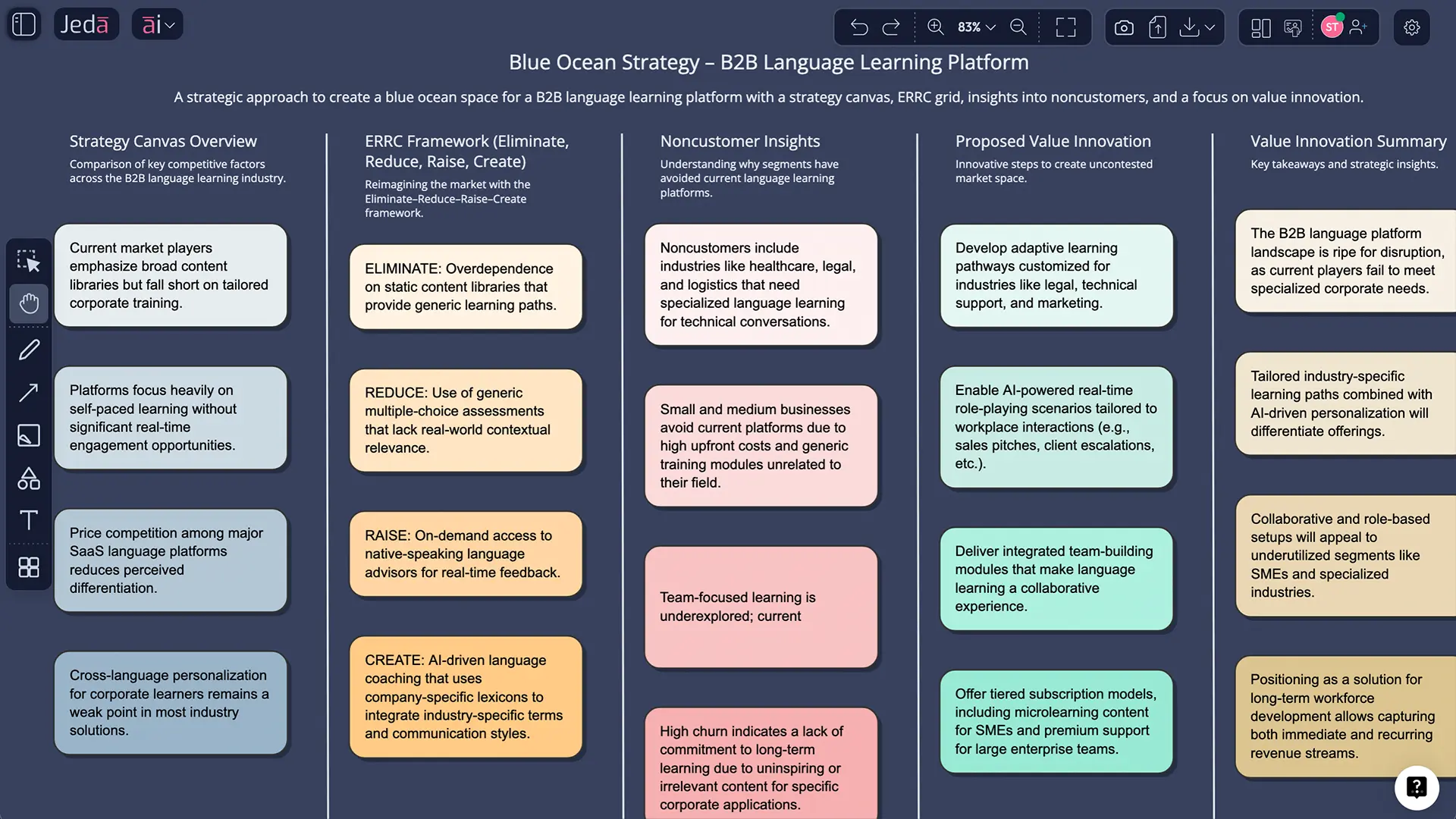
Build a Blue Ocean Strategy template for a B2B language learning platform serving global sales teams. Include a strategy canvas, competitors, eliminate-reduce-raise-create grid, value innovation angle, noncustomer opportunities, and a shortlist of assumptions to validate.
Press Enter to generate. Then edit the board, add missing factors, and challenge the output with live team comments.
What to do after generation
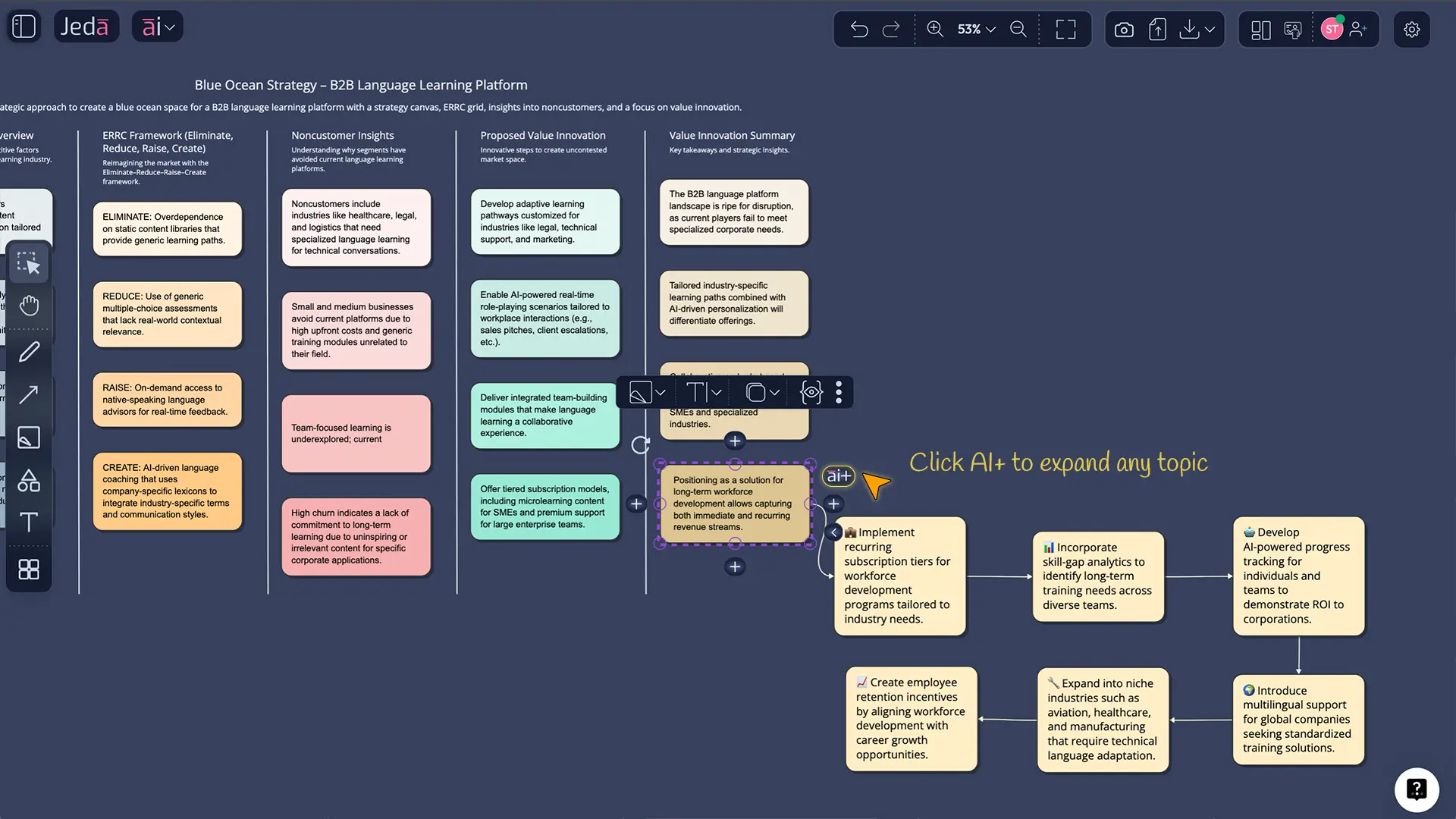
Use the AI+ button to extend the board into a deeper analysis. Keep that extension broad. In this workflow, AI+ works best as a general deep dive layer rather than a place for very narrow instructions.
Then use Vision Transform if you want to convert the matrix into a more presentation-friendly diagram or decision map.
- Open the AI Menu
Start in Jeda.ai, open the AI Menu, and choose Matrix Recipes to access the Blue Ocean Framework.
- Select Blue Ocean Framework
Pick the Blue Ocean Framework matrix template and prepare the core inputs: industry, target buyers, direct competitors, and the shift you want to create.
- Add market context
Enter the competitive factors, buyer pain points, and any assumptions worth testing so the first output is grounded, not generic.
- Generate the matrix
Create the board and review the first-pass strategy canvas, ERRC logic, and value innovation direction with your team on the canvas.
- Refine in the Prompt Bar
Use the Matrix command in the Prompt Bar to sharpen the output, compare scenarios, or generate another version for a different segment.
- Extend and transform
Tap the AI+ button for a broader deep dive, then use Vision Transform to convert the matrix into a diagram, roadmap, or workshop-ready visual.
Blue Ocean Strategy example: a language learning platform stops selling “more lessons”
Here is a worked example. Not hypothetical in spirit, only in brand name.
Imagine a language learning platform in a very crowded market. Everyone competes on lesson volume, streak mechanics, price, gamification, and celebrity marketing. It is a red ocean. Loud. Familiar. Expensive.
Now the team reframes the category. Instead of “language learning for everyone,” they target global sales teams that need high-stakes meeting fluency, not generic fluency.
The strategy canvas changes immediately.
- Eliminate: vanity lesson counts, broad lifestyle content
- Reduce: streak obsession, mass-market gamification
- Raise: industry vocabulary depth, confidence in live speaking scenarios
- Create: meeting simulations, role-play feedback, manager visibility, deal-specific rehearsal
That is a blue ocean move because the offer is no longer trying to beat generic language apps at their own game. It is redefining the job. The buyer is not “someone who wants to learn a language.” The buyer is a revenue team that wants better meeting outcomes across markets.
Once the board is generated in Jeda.ai, the team can compare a baseline strategy canvas against a proposed new value curve, add noncustomer analysis, and convert the result into a stakeholder-ready diagram inside the same AI Whiteboard.
Best practices for using Blue Ocean Strategy with AI
A few things separate a useful blue ocean session from a board full of attractive nonsense.
And one more thing. Push the team to delete something meaningful. If nothing gets eliminated or reduced, odds are high the strategy is still red ocean thinking in a nicer outfit.
Common mistakes to avoid
Mistaking differentiation for Blue Ocean Strategy
A premium version of the same category is not automatically a blue ocean move. Sometimes it is just a shinier red boat.
Copying the framework vocabulary without changing the offer
Teams often fill an ERRC Grid with decent words but keep the business model nearly intact. That is decorative strategy.
Ignoring noncustomers
If every insight comes from current users, the move is likely too narrow. Blue Ocean Strategy gets stronger when it studies people who avoid the category, reject it, or never considered it.
Building the canvas with the wrong factors
A strategy canvas becomes weak when it tracks whatever the company already reports internally instead of the factors buyers actually use to compare offers.
Treating the first AI output as final
Bad idea. AI is a strong first pass, not an excuse to skip judgment. Review the board, push on assumptions, and generate alternatives before you commit.
Frequently asked questions
- What is Blue Ocean Strategy in simple terms?
- Blue Ocean Strategy is a framework for creating uncontested market space instead of competing head-to-head in crowded markets. It aims to make competition less relevant by designing a leap in buyer value while also managing cost.
- What is the difference between blue ocean and red ocean strategy?
- Red ocean strategy competes inside existing demand where rivals already define the rules. Blue ocean strategy tries to create new demand by changing the value proposition, buyer focus, or category logic so direct comparison becomes weaker.
- What is a Blue Ocean Strategy template?
- A Blue Ocean Strategy template is a structured visual board that usually includes a strategy canvas, competitor comparison, and an ERRC grid. It helps teams move from broad discussion to concrete value-curve decisions.
- What is the Strategy Canvas used for?
- The Strategy Canvas shows how your offer compares with competitors across the factors the market competes on. It helps teams see sameness, spot overinvestment, and design a distinct value curve for a new strategic move.
- What is the Four Actions Framework?
- The Four Actions Framework asks what to eliminate, reduce, raise, and create. It is the practical core of Blue Ocean Strategy because it forces teams to redesign value rather than simply add more features or marketing claims.
- What is the ERRC Grid?
- The ERRC Grid is the matrix version of the Four Actions Framework. It helps teams organize strategic choices into eliminate, reduce, raise, and create buckets so tradeoffs become visible and easier to challenge.
- Can AI help create a Blue Ocean Strategy?
- Yes, AI can speed up framing, comparison, and scenario generation. In Jeda.ai, you can generate the Blue Ocean Framework, edit it on the canvas, extend it with AI+, and transform it into another visual without leaving the same workspace.
- Who should use Blue Ocean Strategy?
- Strategy consultants, founders, product leaders, and business teams use it when markets feel crowded, features are converging, and pricing pressure is rising. It is especially useful when you need a clear repositioning rather than another minor upgrade.
- How often should a Blue Ocean Strategy board be revisited?
- Revisit it when buyer behavior shifts, new substitutes emerge, or the team is planning a major offer change. For active growth teams, a quarterly review is usually more useful than treating the framework as a once-a-year workshop artifact.
- What are the most important Blue Ocean sub-frameworks?
- The most widely used tools are the Strategy Canvas, Four Actions Framework, ERRC Grid, Six Paths Framework, Three Tiers of Noncustomers, Buyer Utility Map, and the value innovation principle that connects them all.
- Can startups use Blue Ocean Strategy, or is it only for big companies?
- Startups can use it very effectively because they are often more willing to challenge industry assumptions. The framework helps small teams avoid feature-chasing and instead focus on creating a sharper, more defensible market position.
Sources & further reading
- [1]
Kim, W. Chan; Mauborgne, Renée (2004) . “Blue Ocean Strategy” Harvard Business Review.
View Source ↗ - [2]
Kim, W. Chan; Mauborgne, Renée (2004) . “Value Innovation: The Strategic Logic of High Growth” Harvard Business Review.
View Source ↗ - [3]
Kim, W. Chan; Mauborgne, Renée (2026) . “What is Blue Ocean Strategy?” BlueOceanStrategy.com.
View Source ↗ - [4]
Kim, W. Chan; Mauborgne, Renée (2026) . “Strategy Canvas” BlueOceanStrategy.com.
View Source ↗ - [5]
Kim, W. Chan; Mauborgne, Renée (2026) . “Four Actions Framework” BlueOceanStrategy.com.
View Source ↗ - [6]
Kim, W. Chan; Mauborgne, Renée (2026) . “Eliminate-Reduce-Raise-Create (ERRC) Grid” BlueOceanStrategy.com.
View Source ↗ - [7]
Kim, W. Chan; Mauborgne, Renée (2026) . “Six Paths Framework” BlueOceanStrategy.com.
View Source ↗ - [8]
Kim, W. Chan; Mauborgne, Renée (2017) . “Blue Ocean Shift: Beyond Competing – Proven Steps to Inspire Confidence and Seize New Growth” Grand Central Publishing.
View Source ↗ - [9]
IMD (2025) . “What is Blue Ocean Strategy and How To Implement It” IMD.
View Source ↗
Start Your Blue Ocean Strategy in Jeda.ai
Join over 150,000+ users who use Jeda.ai as an AI Workspace and AI Whiteboard for faster strategy work, sharper decisions, and editable visual outputs.
Try Free Template