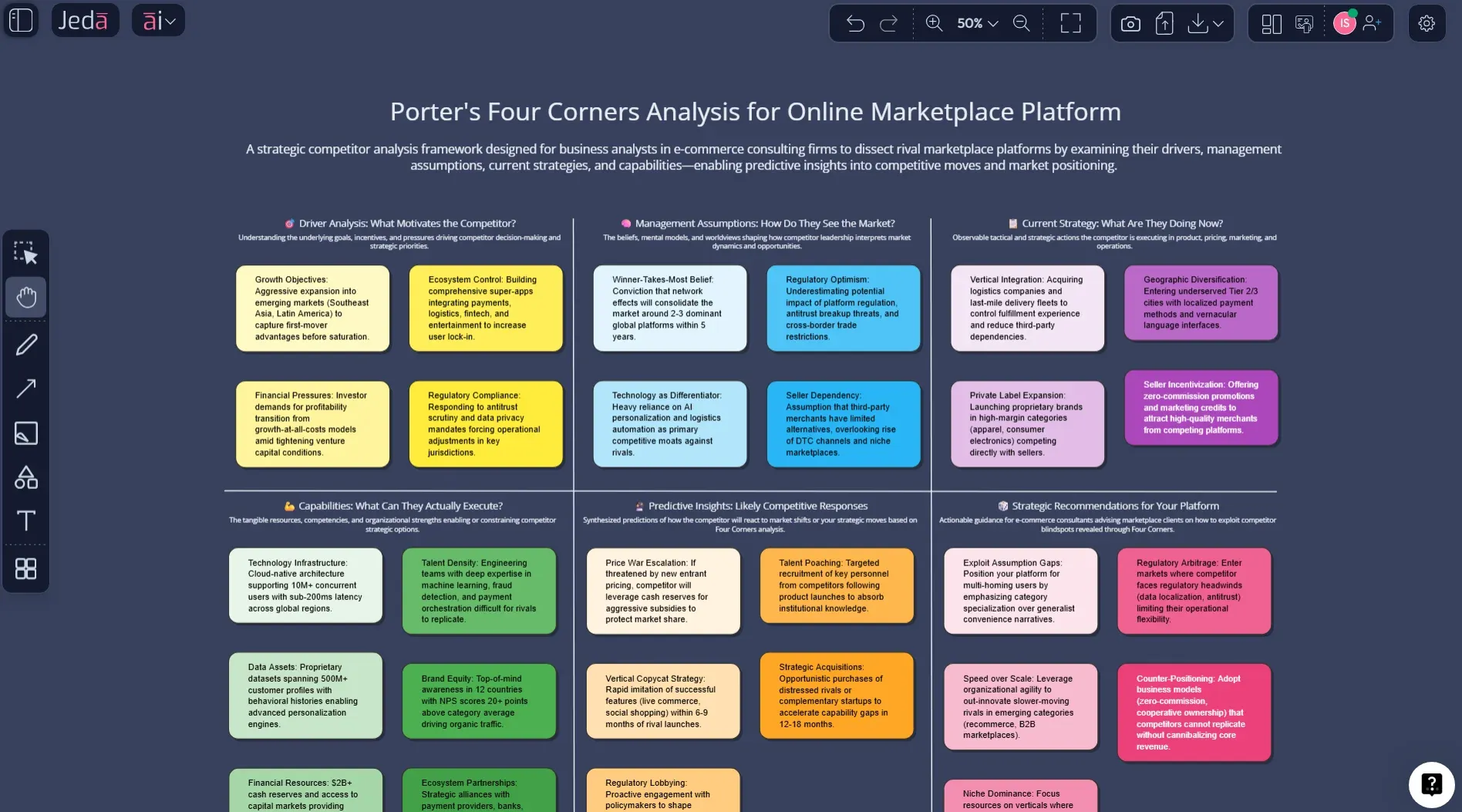
Porter’s Four Corners Analysis with AI gives you something most competitor templates never quite manage: a disciplined way to predict what a rival is likely to do next, not just a tidy recap of what they did last quarter. In Jeda.ai, you can build that analysis inside one AI Workspace, keep the evidence visible, and refine the board with your team inside the same AI Whiteboard instead of juggling docs, slides, and half-finished notes. That matters when the goal is prediction, because prediction falls apart the second context gets scattered. If you want the wider platform context, the work sits naturally alongside Jeda.ai’s AI Workspace and AI Whiteboard pages, where these strategy boards usually live.
This is also where Jeda.ai earns its keep. You can start with a matrix recipe, extend one corner with the AI+ button, convert the output into a different visual if the discussion evolves, and keep the whole thing editable. No dead-end screenshot. No static diagram that becomes obsolete the moment your competitor changes pricing. With 150,000+ users and 300+ strategic frameworks, Jeda.ai gives strategy teams a Visual AI workflow that feels built for live thinking rather than post-meeting archaeology.
What is Porter's Four Corners Analysis?
Porter’s Four Corners Analysis is a competitor analysis framework designed to estimate a rival’s likely future behavior. Its intellectual roots sit in Michael Porter’s Competitive Strategy, where competitor analysis is organized around four inputs: future goals, assumptions, current strategy, and capabilities. Those four inputs feed what Porter calls a competitor response profile. In plain English, the model asks a hard question: given what this competitor wants, believes, is doing, and can actually execute, what are they likely to do when the market shifts?
That’s why Four Corners matters. Many teams over-index on visible moves—pricing changes, feature launches, headcount, partnerships. Useful data, yes. But incomplete. If your team first needs the broader umbrella view, start with Porter’s analysis or Porter’s Five Forces, then come back to Four Corners for the rival-specific prediction layer. Porter’s real move was to insist that motivation and assumptions matter just as much as observable strategy. A well-funded rival with weak conviction may react slowly. A smaller rival with strong dissatisfaction and a clear leadership agenda may move faster than expected. Same market. Very different response profile.
You’ll also see the model labeled with slightly different language in modern practice:
- Future goals is often simplified to motivation drivers
- Assumptions becomes management assumptions
- Current strategy keeps its name
- Capabilities keeps its name too
The relabeling is fine. The logic stays the same.
And here’s the practical distinction. Porter’s Five Forces explains industry pressure. Porter’s Four Corners explains a competitor’s likely behavior inside that pressure. So if Five Forces tells you the battlefield, Four Corners tells you which rival is most likely to charge, defend, retreat, or bluff. Different job entirely.
Why use Porter's Four Corners Analysis with AI?
Done badly, Four Corners becomes a glorified opinion board. Done well, it becomes a structured forecasting exercise. AI helps because it speeds up synthesis, exposes gaps, and makes scenario testing less painful. You still need judgment. You still need evidence. But you don’t need to waste half the workshop formatting sticky notes or rewriting the same competitor story in three places.
- Sharper competitor framing
Jeda.ai helps you organize goals, assumptions, strategy, and capabilities in one view so your team stops mixing signals from different rivals.
- Faster hypothesis building
You can generate an initial matrix quickly, then refine each corner with evidence from market notes, product releases, interviews, and internal observations.
- Better risk anticipation
Four Corners is really about anticipated retaliation and likely initiative. AI helps your team model those possibilities without turning the session into chaos.
- Live collaboration
Competitive analysis is rarely a solo act. Product, strategy, sales, and leadership can challenge assumptions together inside the same AI Whiteboard.
- AI+ for deeper branches
Use the AI+ button to extend one quadrant after the first matrix exists on canvas. That makes the follow-up reasoning more grounded and less generic.
- One board, multiple views
Start in Matrix, then turn the output into a Diagram if you want a response tree, scenario map, or executive summary inside the same AI Workspace.
Another advantage is traceability. In Jeda.ai, you can attach reasoning to the board instead of burying it in a side document no one opens again. That makes the final prediction more auditable. And frankly, less flimsy.
How to create Porter's Four Corners Analysis in Jeda.ai
For this framework, follow the workflow your team asked for: Method 1: Recipe Matrix first, then Method 2: Prompt Bar when you want more control. The matrix route is the cleanest way to generate the core structure. The Prompt Bar is the better option when the competitor situation is unusual or you need a more custom angle.
Method 1: Recipe Matrix
Use the recipe-led matrix when you want a consistent, board-ready structure. This is the recommended path for workshops, academic exercises, and team sessions where several people need to understand the logic quickly.
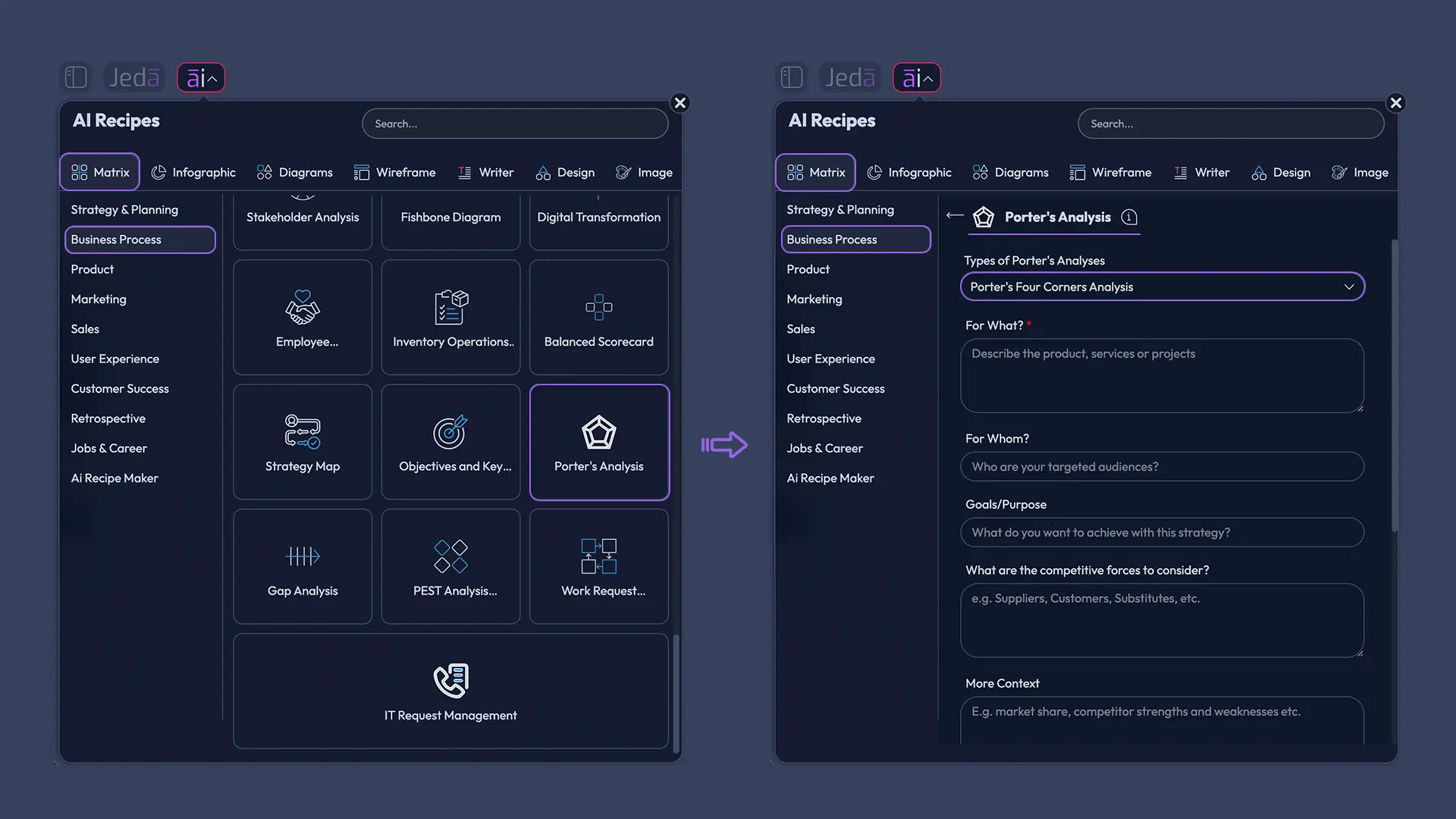
- Open the AI Menu and choose the Matrix recipe
From the canvas, open the AI Menu, go to Matrix Recipes, and select the Porter’s Four Corners Analysis recipe.
- Define the focal competitor and decision context
Be precise about who the rival is and why you are analyzing them. Include the market, geography, customer segment, and the strategic decision you need to inform.
- Generate the four-corner matrix
Ask Jeda.ai to structure the board around future goals, management assumptions, current strategy, and capabilities, with a short response-profile conclusion.
- Replace generic claims with evidence
Edit each quadrant using real signals such as earnings language, hiring patterns, partnerships, pricing actions, leadership comments, and product direction.
- Highlight likely offensive and defensive moves
Add a short section on likely triggers, probable responses, and the moves your competitor is most likely to take seriously.
- Use the AI+ button to deepen one corner
After the matrix is on canvas, select one quadrant and use AI+ to extend it with deeper rationale or scenario implications. AI+ works best as an extension of existing content, not as a brand-new blank request.
Method 2: Prompt Bar
The Prompt Bar works better when you already know what matters and you want to steer the output more tightly.
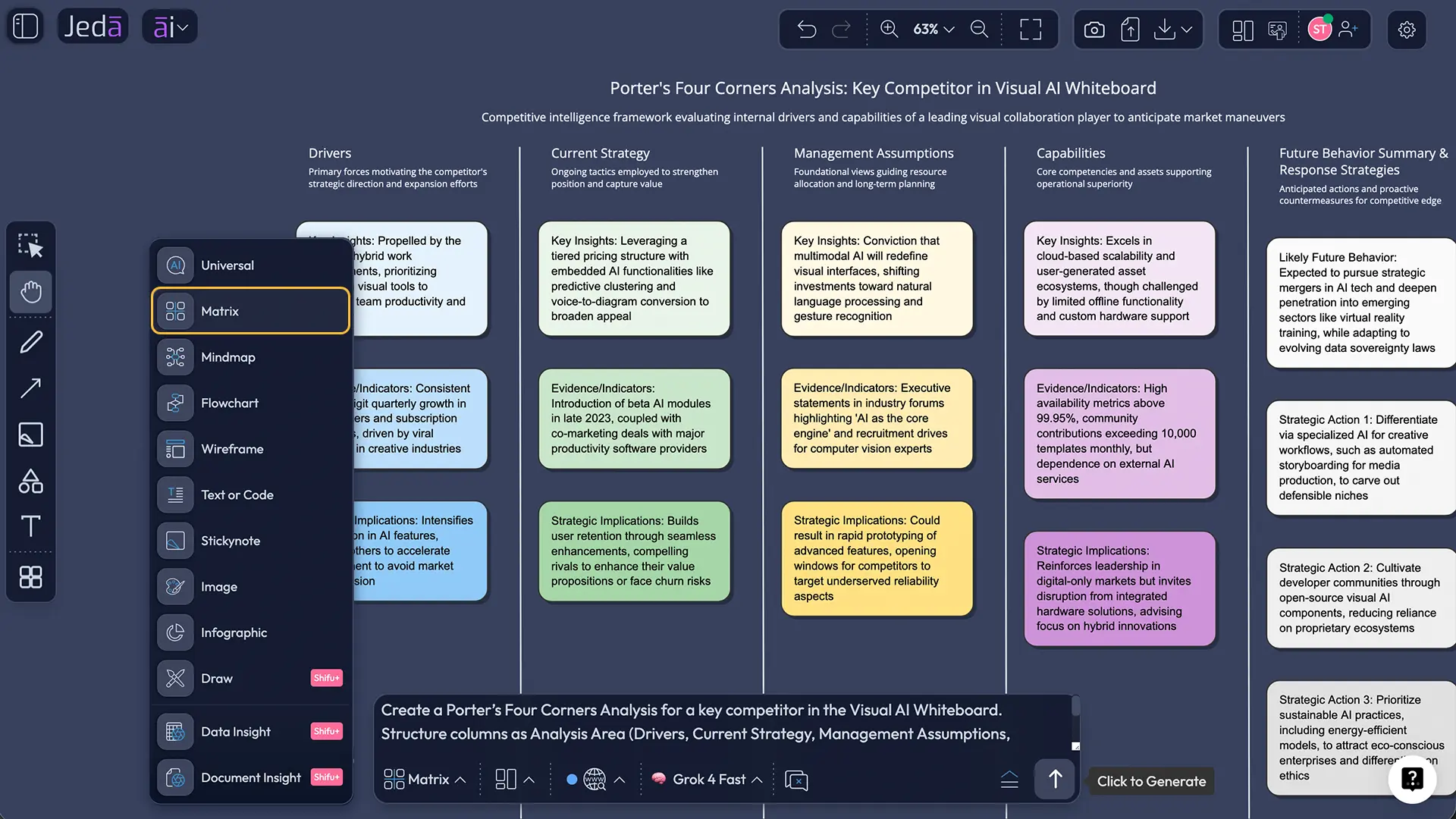
Open the Prompt Bar at the bottom of the canvas. Select the Matrix command. Then use a prompt like this:
Create a Porter’s Four Corners Analysis for a mid-market project management SaaS competitor in North America. Organize the output into future goals, management assumptions, current strategy, and capabilities. End with the competitor’s likely response profile if we launch AI workflow automation for enterprise teams.
Then review the draft and tighten every corner. AI can structure a strong first pass, but competitor prediction improves only when the team adds evidence. A board full of vague adjectives is still vague, even when the layout looks impressive.
After that, you can do two useful follow-ups in Jeda.ai:
- Select a quadrant and tap AI+ to deepen it.
- Use Vision Transform if you want to convert the matrix into a scenario diagram or decision tree for leadership review.
What does each corner actually tell you?
This is where many teams get sloppy. They fill the boxes, then pretend the job is done. It isn’t. Each corner answers a different question, and the analysis only works when you keep those questions distinct.
Future goals
This corner asks what the rival is trying to achieve. Growth? Margin defense? Prestige? Geographic expansion? A successful exit? If management is under pressure to close a growth gap, the firm may tolerate risk. If leadership is trying to stabilize margins, the firm may react defensively instead.
Assumptions
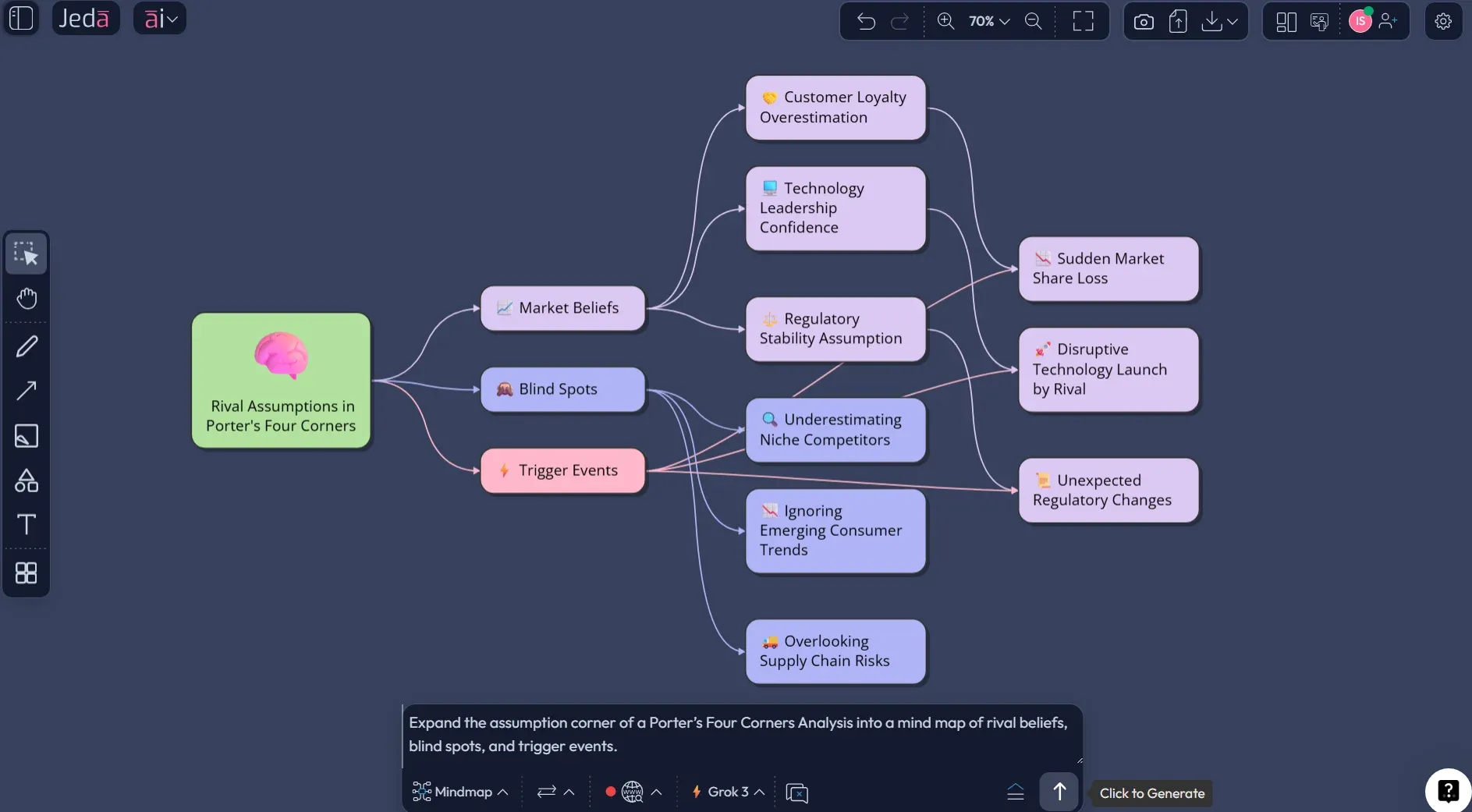
Assumptions are the rival’s beliefs about itself, the market, customers, and competitors. This corner matters because bad assumptions create predictable blind spots. A firm that believes enterprise buyers will not switch may underreact. A firm that believes it has superior brand insulation may double down when it should pivot.
Current strategy
This one is visible. Pricing, product bundles, channel moves, messaging, partnerships, hiring patterns, feature emphasis. Useful, yes. But it describes present behavior, not necessarily future intent.
Capabilities
Capabilities answer the ugly but necessary question: even if the rival wants to move, can it? Financial capacity, data assets, engineering speed, sales coverage, brand trust, distribution, regulatory experience, partner network. Plenty of companies have ambition that outruns execution. This corner catches that gap.
Porter's Four Corners Analysis template and worked example
Let’s make this concrete. Imagine your team is building AI workflow automation for enterprise project management, and you’re assessing a well-funded incumbent.
A good Four Corners matrix might look like this:
- Future goals: protect enterprise retention, grow average contract value, and prove that recent AI investments are commercially real rather than marketing theatre.
- Management assumptions: believes its installed base is sticky, assumes enterprise customers prefer integrated suites over specialist tools, and views AI as a feature race rather than a workflow redesign problem.
- Current strategy: bundling new AI capabilities into premium plans, pushing enterprise security language, expanding partner integrations, and increasing thought-leadership marketing.
- Capabilities: strong enterprise sales team, credible security posture, large installed base, slower product iteration than smaller rivals, and moderate dependency on legacy architecture.
Now the useful part. Not the pretty part.
From this matrix, the likely response profile may be:
- fast pricing or packaging adjustments
- a strong messaging campaign around trust and scale
- selective feature release rather than full workflow reinvention
- aggressive account-level defense for top customers
- slower structural response if major platform redesign is required
That is already more useful than saying, “They’re a strong competitor.” Of course they are. So is gravity.
Once the first matrix is on the board, use AI+ to extend the assumptions or capabilities quadrant. That is usually where the most informative contradictions appear. Then, if you need an executive-ready output, convert the analysis into a scenario diagram that shows our move → rival response → likely market consequence.
Best practices and tips
Good Four Corners work is disciplined, not decorative. You are not trying to write a biography of the competitor. You are trying to estimate their next moves.
It also helps to add timestamps. Competitor intent changes. A Four Corners board without timing can age badly.
Common mistakes to avoid
The first mistake is confusing current strategy with the whole model. Many teams spend 80% of their time on visible actions and barely touch future goals or assumptions. That guts the predictive value.
Second, analysts often write assumptions as facts. They are not facts. They are inferred beliefs. Label them honestly.
Third, teams use weak evidence for capabilities. A press release is not proof of delivery capability. A funding round is not proof of execution speed. Money helps. It does not code the product.
Fourth, the board gets built around one dramatic competitor move and ignores the wider pattern. A single launch can mislead. Look for repeated behavior.
And finally, people forget that Four Corners is a live framework. If your rival replaces the CEO, misses guidance, or changes pricing architecture, the matrix should move too. Static competitor analysis is mostly nostalgia with formatting.
Frequently Asked Questions
- What is Porter's Four Corners Analysis used for?
- Porter’s Four Corners Analysis is used to estimate a competitor’s likely future behavior. It organizes evidence around future goals, assumptions, current strategy, and capabilities, then turns those inputs into a response profile.
- Is Porter's Four Corners Analysis the same as Five Forces?
- No. Five Forces analyzes industry structure and profit pressure across a market. Four Corners focuses on a specific competitor and predicts how that rival is likely to react or initiate strategic moves.
- Who created the Four Corners model?
- The framework is attributed to Michael E. Porter and is grounded in his competitor analysis work in *Competitive Strategy*. The modern shorthand labels differ slightly, but the underlying four-part logic remains consistent.
- What are the four corners in the model?
- The four corners are future goals, assumptions, current strategy, and capabilities. Many practitioners relabel future goals as motivation drivers and assumptions as management assumptions, but the analytical purpose stays the same.
- What makes Four Corners predictive?
- The model is predictive because it combines what a competitor wants, what it believes, what it is doing now, and what it can realistically execute. That combined picture is more useful than strategy observation alone.
- How is AI useful for Four Corners Analysis?
- AI speeds up synthesis, structure, and scenario expansion. In Jeda.ai, it helps teams draft the initial matrix, refine each corner, extend specific quadrants with AI+, and turn the final logic into an editable visual board.
- Which Jeda.ai command should I use for this framework?
- Start with the Matrix command or the Matrix recipe because Four Corners is easiest to read as a structured four-part board. If leadership wants a response tree afterward, convert the result with Vision Transform.
- Can I use AI+ to ask for a brand-new analysis?
- AI+ is best used to extend what already exists on canvas. Build the first Four Corners matrix first, then select a quadrant and use the AI+ button to deepen or continue that part of the analysis.
- What evidence belongs in the capabilities corner?
- Use evidence that reflects real execution capacity: product shipping speed, balance-sheet strength, enterprise coverage, partner reach, regulatory expertise, operational depth, and technical constraints. Marketing claims alone are not enough.
- Can I do this in Jeda.ai with a team?
- Yes. Jeda.ai supports real-time collaboration inside one AI Workspace, which makes Four Corners far more useful because strategy, product, sales, and leadership can challenge the same board together.
Sources & Further Reading
- [1]
Porter, Michael E. (1980) . “Competitive Strategy: Techniques for Analyzing Industries and Competitors” Free Press / Harvard Business School Faculty & Research.
View Source ↗ - [2]
Chen, Ming-Jer (1996) . “Competitor Analysis and Interfirm Rivalry: Toward a Theoretical Integration” Academy of Management Review.
View Source ↗ - [3]
Alverson, Brianna N. (2020) . “Porter’s Four Corners: An Argument for Counterterrorism Analysis Utility” American Intelligence Journal.
View Source ↗ - [4]
Porter, Michael E. (n.d.) . “Strategy Explained” Institute for Strategy and Competitiveness, Harvard Business School.
View Source ↗ - [5]
Bergen, Mark, and Margaret Peteraf (2002) . “Competitor Identification and Competitor Analysis: A Broad-Based Managerial Approach” Managerial and Decision Economics.
View Source ↗
Start Your Porter's Four Corners Analysis Today
Join 150,000+ users who use Jeda.ai to turn competitor signals into editable, collaborative strategy boards inside one AI Workspace.
Try Free Template