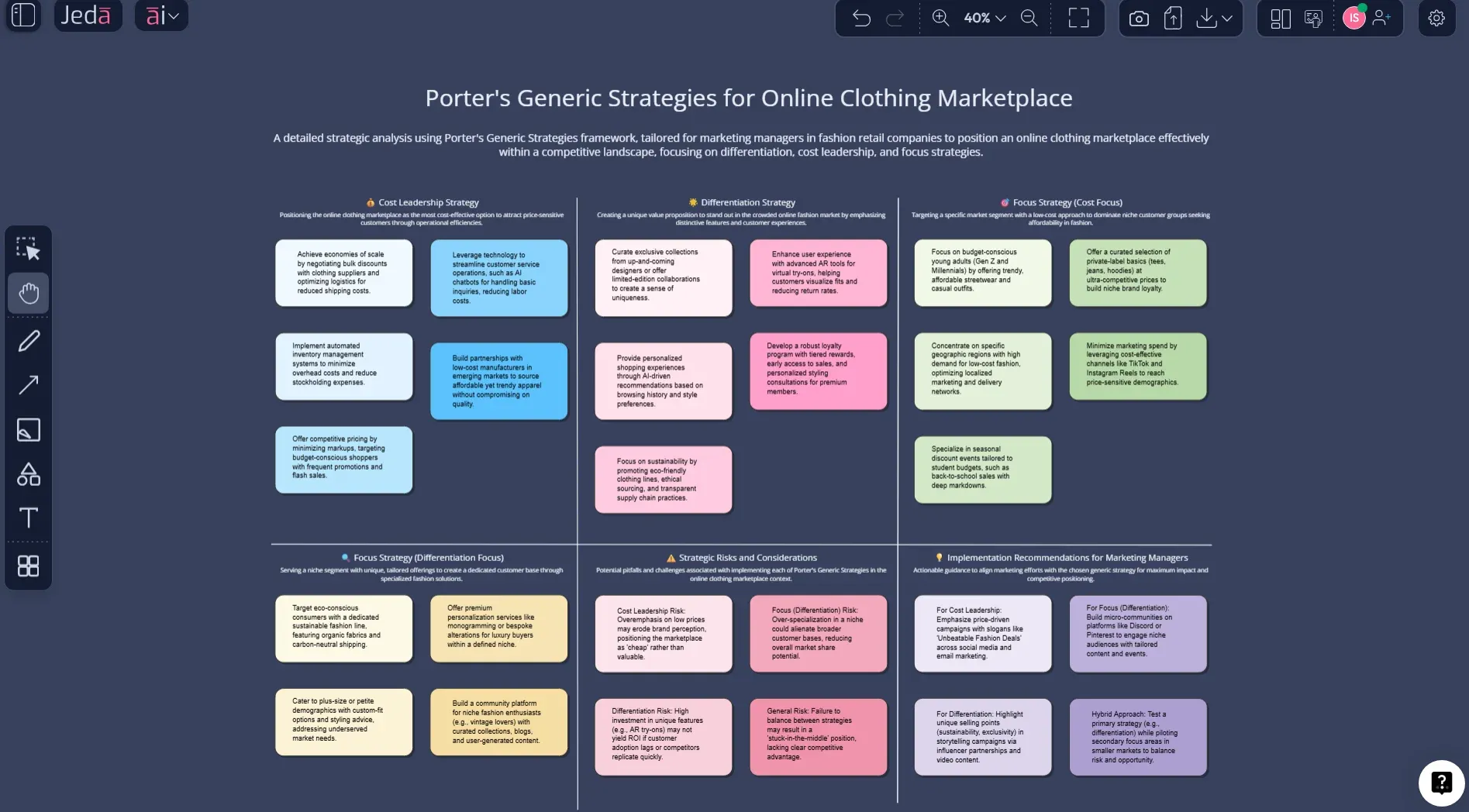
Porter’s Generic Strategies with AI is not about finding a clever slogan for your brand. It is about deciding how you will compete when customers, costs, rivals, and trade-offs start pulling in different directions. In Jeda.ai, you can map the logic inside one AI Workspace, compare cost leadership, differentiation, and focus on the same board, then sharpen the choice inside an editable AI Whiteboard instead of splitting the reasoning across slides, notes, and half-finished spreadsheets.
That matters because Porter’s generic strategies are unforgiving. A fuzzy position looks harmless in a workshop. In the market, it burns cash. Teams drift into mixed signals, bloated offers, inconsistent pricing, and what Porter famously called being stuck in the middle. Jeda.ai helps you see that drift early. Start with a Recipe Matrix, compare the options side by side, extend one path using the AI+ button, and convert the result to another visual if leadership wants a cleaner story. With 150,000+ users, 300+ strategic frameworks, and a practical Visual AI workflow, Jeda.ai turns a classic strategy model into something teams can pressure-test rather than just admire.
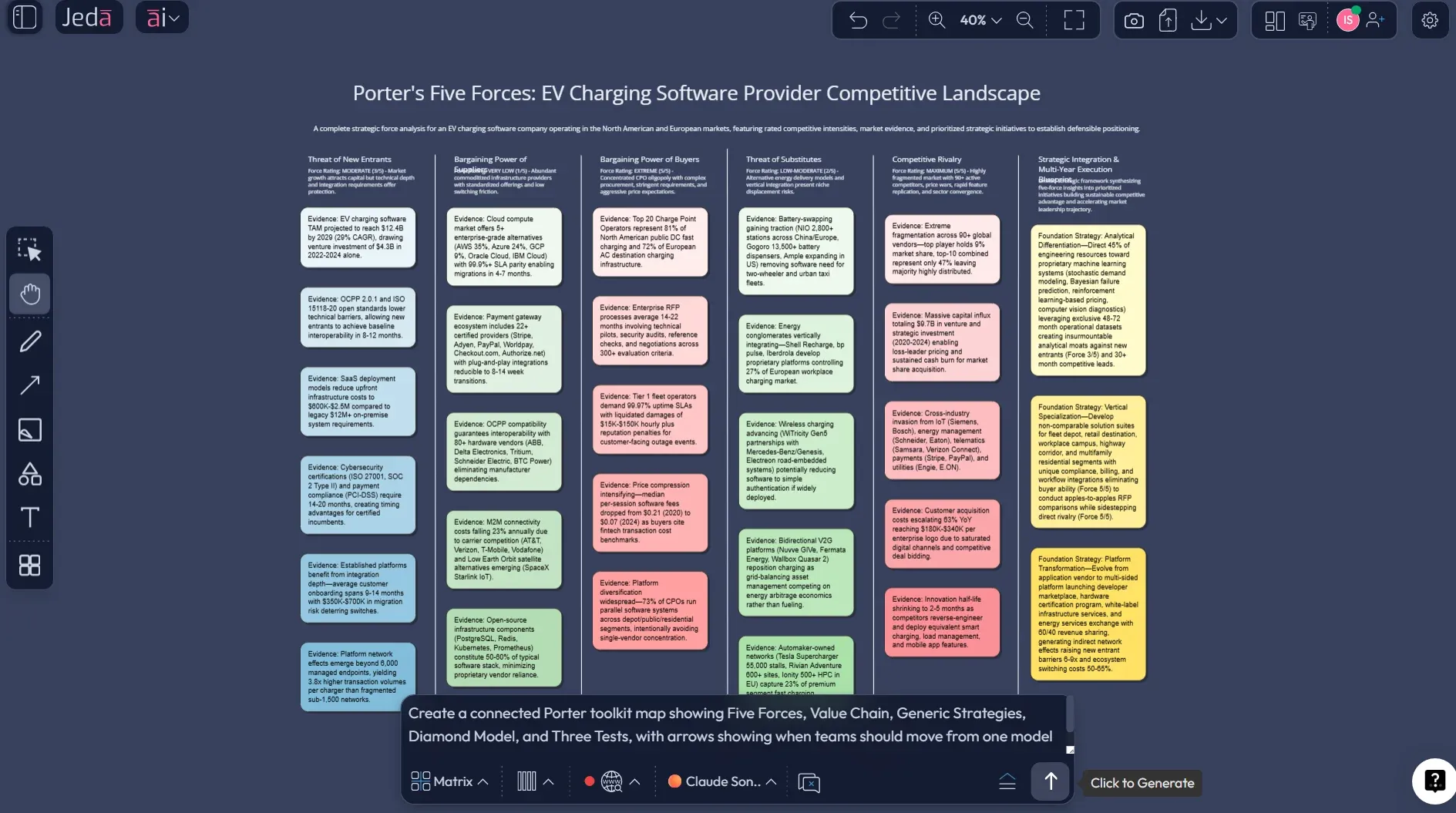
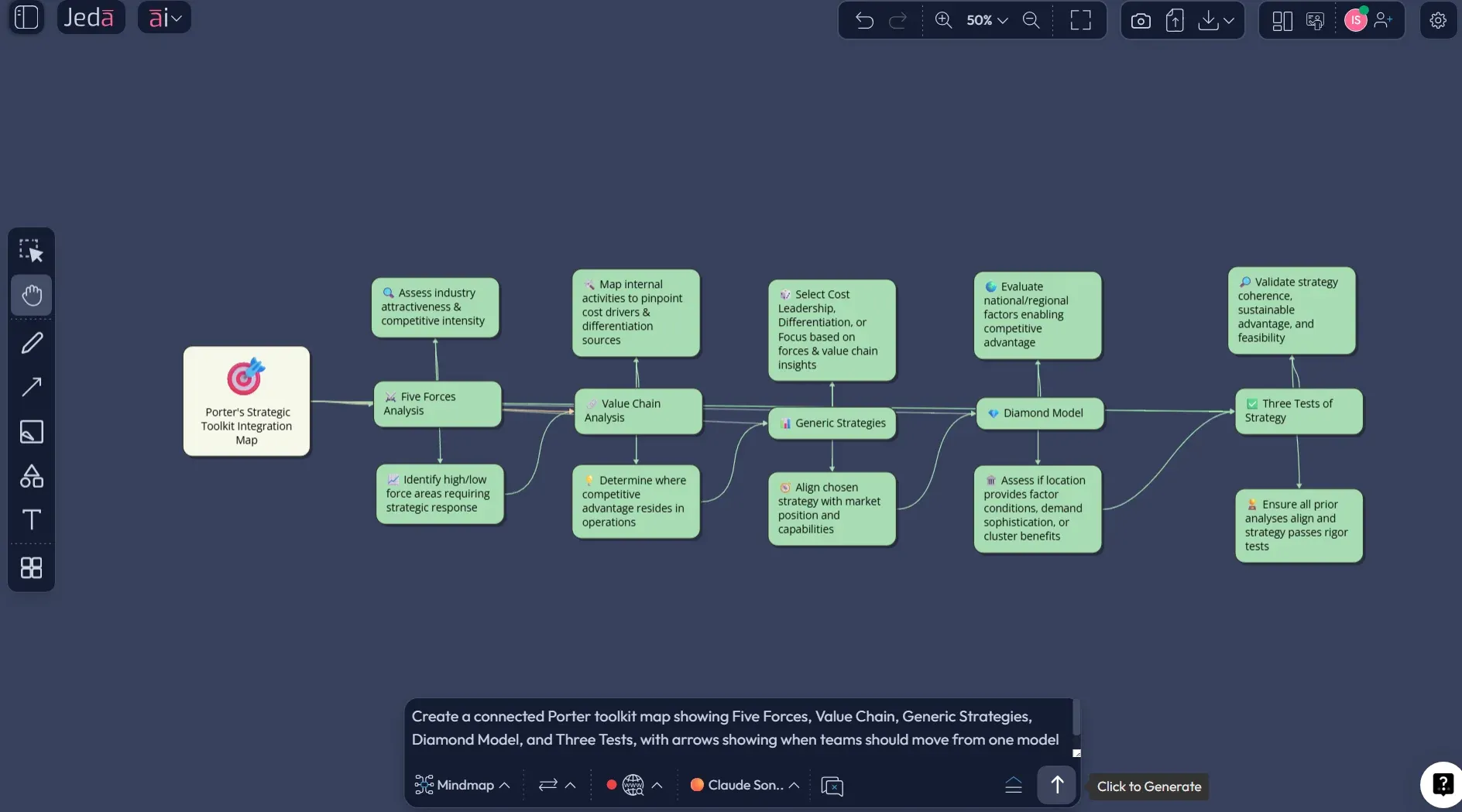
This page also sits naturally with Jeda.ai’s AI Workspace, AI Whiteboard, Porter’s Five Forces, and Porter’s Value Chain pages, because the frameworks feed each other. Five Forces tells you what the market is doing to margins. Generic Strategies tells you how to answer.
What are Porter's Generic Strategies?
Porter’s Generic Strategies is a framework for choosing a broad basis of competitive advantage inside an industry. In Porter’s 1980 and 1985 work, the core idea is direct: firms outperform rivals by achieving either lower cost or differentiation, and they may apply that advantage across a broad market or within a narrower target segment. That produces three classic strategic positions:
- Cost leadership
- Differentiation
- Focus — with cost focus and differentiation focus as the two practical variants
The framework sounds neat on paper because Porter was trying to force a hard managerial choice. You cannot serve every customer, offer every feature, keep prices low, preserve premium signals, and avoid trade-offs forever. At some point, the operating model has to line up with the positioning.
That is why this framework still works.
Cost leadership
A cost leader aims to produce at a lower cost than rivals while maintaining acceptable value. This does not mean “cheap” in the sloppy sense. It means a system of activities, processes, procurement choices, scale advantages, and design decisions that support lower delivered cost.
Differentiation
A differentiator creates distinctive value that buyers recognize and are willing to pay for. That distinctiveness can come from design, service, trust, speed, ecosystem, brand, technical capability, domain expertise, or a combination of those.
Focus
A focuser serves a narrower segment better than broad-market rivals do. The edge may come from lower cost within that segment or from highly tailored differentiation. Focus is not smallness for its own sake. It is strategic concentration.
And then comes the warning label.
Stuck in the middle
Porter argued that firms trying to pursue incompatible advantages without real fit could end up stuck in the middle. That phrase gets overused, but the underlying problem is real: the company lacks the cost structure of a cost leader and the distinctive value of a differentiator. It becomes expensive without being special or special without being sufficiently different.
Why use Porter's Generic Strategies with AI?
This framework is built on comparison, trade-offs, and fit across activities. AI helps because it makes those comparisons easier to see, easier to revise, and harder to fake. When your team puts the three positions on one board, weak logic becomes visible fast.
- Clear side-by-side comparison
Jeda.ai lets you compare cost leadership, differentiation, and focus on one canvas so the trade-offs show up before the strategy memo does.
- Sharper positioning choices
You can pressure-test whether your offer truly supports a broad-market strategy, a premium differentiated strategy, or a focused niche play.
- AI+ for deeper path analysis
Use AI+ after the first matrix exists to deepen one strategic path, expand the activity implications, or explore what being stuck in the middle would look like.
- Link position to operations
This matters because generic strategy is not only a messaging choice. It is a value chain choice, pricing choice, and capability choice.
- Cross-team alignment
Product, finance, go-to-market, and leadership can challenge the same strategic posture together inside the AI Whiteboard instead of debating from separate decks.
- Easy conversion to other visuals
Start in Matrix, then convert to a Diagram or Mindmap when you want a strategy tree, leadership summary, or implementation map.
The hidden win is honesty. Most teams say they are differentiated when they really mean “we offer more features.” That is not the same thing. Sometimes it is not even close. A good board forces the team to answer harder questions. Which buyers? What premium? Which activity trade-offs? Which costs are intentionally accepted? Which costs must disappear?
How to create Porter's Generic Strategies in Jeda.ai
Method 1: Recipe Matrix
Use the matrix method when you want a structured comparison between the positions and the operating implications of each one.
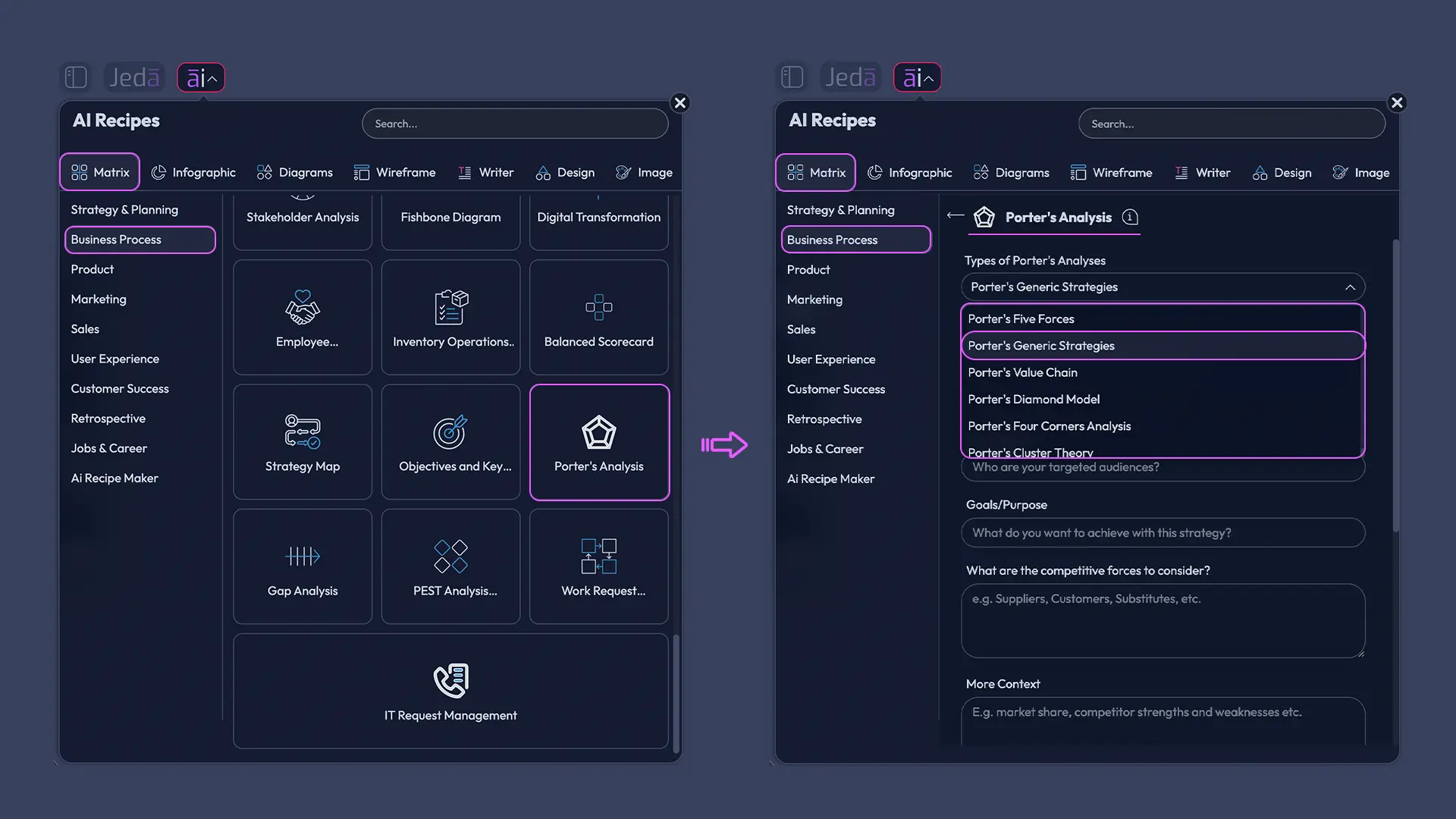
- Open the AI Menu and choose the Matrix recipe
Open the AI Menu on the canvas, go to Matrix Recipes, and select the Porter’s Generic Strategies recipe.
- Define the company, market, and customer segment
Tell Jeda.ai what company type you are analyzing, who it serves, the geography, and the strategic decision at hand.
- Generate the three-position framework
Ask Jeda.ai to structure the board around cost leadership, differentiation, and focus, and to note the risks of being stuck in the middle.
- Attach real activity implications
Edit each strategy with concrete moves involving pricing, product scope, service model, procurement, channel choices, and capability requirements.
- Mark trade-offs and non-choices
State what the company will not do under each strategic path. Good strategy becomes clearer when you write the exclusions as well as the ambitions.
- Use AI+ to deepen the chosen path
Once the matrix is on canvas, select your most plausible position and use AI+ to expand it into execution risks, fit requirements, or a one-year roadmap.
Method 2: Prompt Bar
The Prompt Bar is better when the company’s situation is unusual or when the market already has strong constraints.
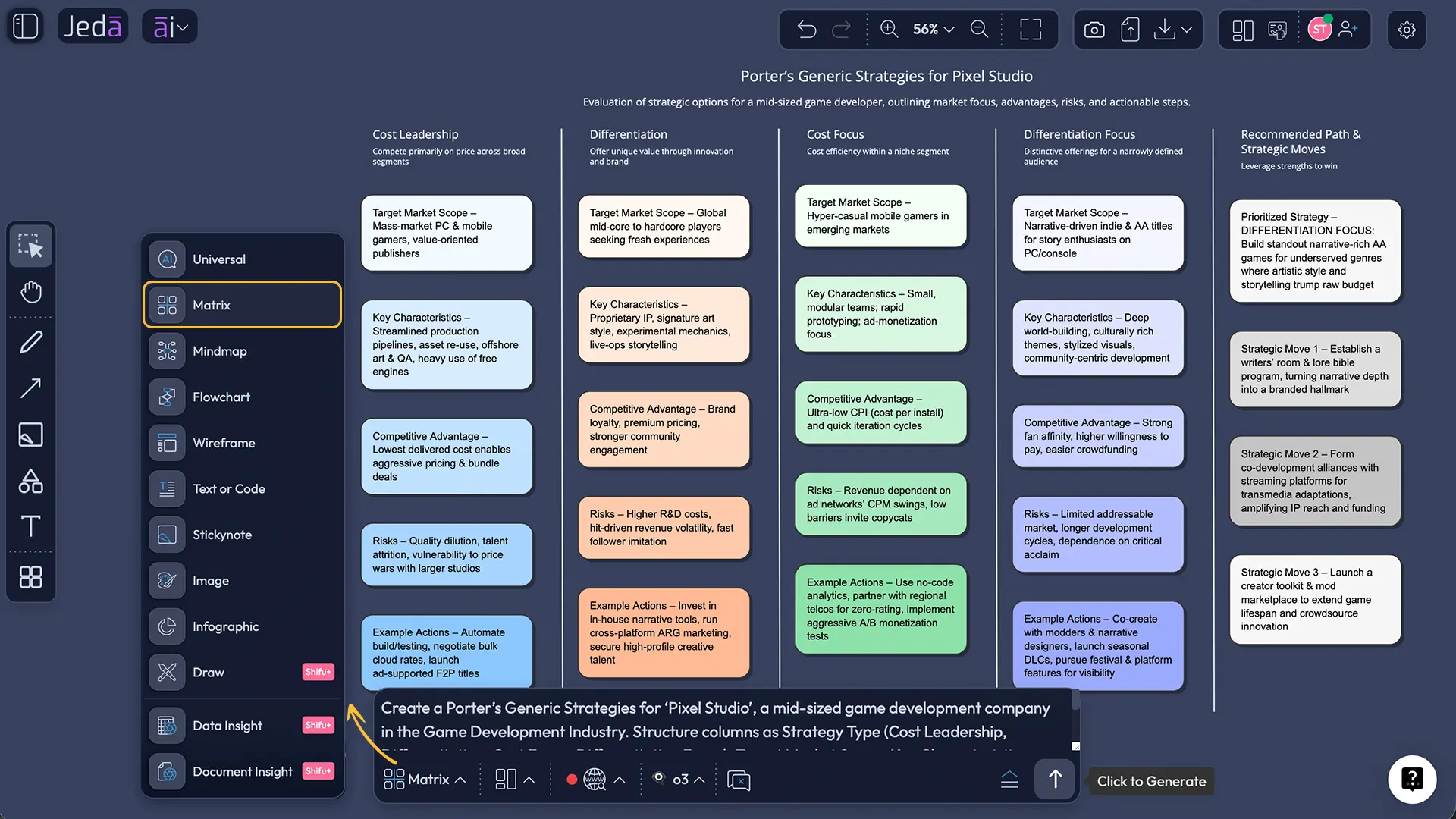
Open the Prompt Bar. Select the Matrix command. Then use a prompt like this:
Create a Porter’s Generic Strategies analysis for a workflow automation SaaS company serving mid-market finance teams. Compare cost leadership, differentiation, and focus. For each option, include likely value proposition, pricing logic, required capabilities, major trade-offs, and the risk of being stuck in the middle.
The output gives you a solid first structure. Then do the real work.
Challenge the assumptions. Add evidence from your pricing, win-loss notes, product roadmap, support model, and operating costs. Then use AI+ to deepen one path. AI+ is there to continue or expand what is already on the board, not to replace the first strategic framing step.
How to compare the strategies without fooling yourself
Here is the trap: teams often compare generic strategies as if they were branding themes. They are not. They are systems choices.
A simple comparison looks like this:
- Cost leadership: broad market, lower cost, standardized offers, disciplined operations, minimal unnecessary complexity
- Differentiation: broad or large market, premium or preference-based value, distinct features or service, stronger willingness to accept selected higher costs
- Focus: narrower segment, sharper tailoring, clearer fit, stronger relevance for a specific group of buyers
That comparison helps. It still is not enough.
The better question is: Which set of activities can your company actually sustain better than rivals? Porter later emphasized that competitive advantage rests on choices about activities and fit, not only on verbal positioning. So a serious generic-strategies board must connect position to execution.
Imagine a B2B cybersecurity SaaS company.
- A cost leadership posture may mean standardized onboarding, limited customization, highly efficient support, strong self-serve product design, and price-led expansion.
- A differentiation posture may mean deeper threat intelligence, stronger compliance workflows, premium support, faster incident expertise, and higher switching costs created by trust and integration depth.
- A focus posture may mean specializing in fintech compliance teams or healthcare security operations rather than trying to serve every buyer with the same offer.
Now the uncomfortable part. If the same company claims premium expertise, low price, high-touch onboarding, deep customization, broad-market reach, and aggressive cost discipline all at once, the board should start blinking red. That is usually the beginning of “stuck in the middle,” even if no one wants to say it out loud.
Best practices and tips
A good generic-strategies board is blunt enough to eliminate fantasy.
A second best practice is to name the segment with discipline. “SMBs” is often too broad. “Independent dental practices with 5–20 staff in urban markets” may sound painfully specific, but that is closer to how focus strategy becomes real.
Common mistakes to avoid
One mistake is assuming differentiation simply means “more features.” It might. But often the edge comes from trust, brand, speed, service, user experience, ecosystem, or specialized expertise.
Another mistake is treating focus as a temporary small-company phase rather than a real strategic choice. Focus can be a powerful source of advantage when broad players cannot match relevance without damaging their own economics.
Third, teams misunderstand cost leadership as “cut prices.” Cost leadership is a structural condition, not a discount coupon.
Fourth, they ignore the activity system. Porter’s framework gets shallow fast when the team talks only about customers and never about operations.
And yes, the biggest mistake is pretending trade-offs do not apply. They do. The market always collects its bill.
Frequently Asked Questions
- What are Porter’s Generic Strategies?
- Porter’s Generic Strategies is a framework for choosing a basis of competitive advantage. The classic positions are cost leadership, differentiation, and focus, with focus usually split into cost focus and differentiation focus.
- Who created Porter’s Generic Strategies?
- Michael E. Porter developed the framework in his strategy work from the 1980s, especially Competitive Strategy and Competitive Advantage, to show how firms choose and sustain a position within an industry.
- What is the difference between cost leadership and differentiation?
- Cost leadership aims to compete through lower relative cost, while differentiation aims to create distinctive value that buyers recognize and will often pay more for. Each path requires different choices across activities.
- What does focus mean in Porter’s framework?
- Focus means competing in a narrower segment rather than across the whole market. A focused strategy can pursue either lower cost in that segment or stronger differentiation for that group of buyers.
- What does ‘stuck in the middle’ mean?
- It describes a firm that lacks the low-cost structure of a cost leader and the recognized distinctiveness of a differentiator. The company ends up carrying cost without earning enough advantage from it.
- Can a company pursue both low cost and differentiation?
- Some later research argues that combinations can work in certain contexts, especially digital markets, but the core warning remains useful: without real fit, trying to be everything to everyone usually weakens performance.
- How does AI help with Porter’s Generic Strategies?
- AI helps teams compare positions faster, make trade-offs visible, connect positioning to execution choices, and extend one strategic path with AI+ inside Jeda.ai after the board is already created.
- Which Jeda.ai command fits this framework best?
- Start with the Matrix command or a Matrix recipe because the framework is easiest to understand as a side-by-side comparison. Then convert it to a Diagram if you need a decision path or implementation map.
- Can I use AI+ to create the full strategy board from nothing?
- AI+ works best once content already exists on canvas. Generate the first matrix first, then use AI+ to deepen the chosen path, expand trade-offs, or continue the analysis.
- What should I do after choosing a generic strategy?
- The next step is usually operational design: value chain choices, pricing architecture, target-segment refinement, capability investment, and a roadmap that reflects the trade-offs of the chosen position.
Sources & Further Reading
- [1]
Porter, Michael E. (1980) . “Competitive Strategy: Techniques for Analyzing Industries and Competitors” Free Press / Harvard Business School.
View Source ↗ - [2]
Porter, Michael E. (1985) . “Competitive Advantage: Creating and Sustaining Superior Performance” Free Press / Harvard Business School.
View Source ↗ - [3]
Institute for Manufacturing, University of Cambridge (n.d.) . “Porter’s Generic Competitive Strategies (Ways of Competing)” University of Cambridge.
View Source ↗ - [4]
Kim, Eonsoo, Namwoon Nam, and J.L. Stimpert (2004) . “The Applicability of Porter’s Generic Strategies in the Digital Age” Journal of Management.
View Source ↗ - [5]
Institute for Strategy and Competitiveness (n.d.) . “Strategic Positioning” Harvard Business School.
View Source ↗
Start Your Porter's Generic Strategies Analysis Today
Join 150,000+ users who use Jeda.ai to compare strategic positions, test trade-offs, and build clear choices inside one AI Workspace.
Try Free Template