.webp)
AI Tools for MBA Students That Transform Passive Lectures into Active Learning
AI Tools for MBA Students are redefining how learners interact with classroom content. Instead of passively consuming lectures, students can now engage in real time, collaborate with peers, visualize business strategies, and make data-driven decisions using a range of AI-powered platforms.
From interactive whiteboards and simulation tools to research assistants and collaboration software, these technologies support active learning, foster critical thinking, and enable dynamic problem-solving. As a result, MBA classrooms are becoming more participative, analytical, and results-oriented, helping students better connect theoretical concepts with real-world business applications and improve overall learning outcomes.
TL;DR:
• AI tools turn passive learning into active engagement
• Students retain more when learning is interactive
• Multi-LLM platforms like Jeda.ai streamline EMBA teaching
• Visual AI Whiteboards create dynamic mind maps, flowcharts, and frameworks
• AI transforms readings, cases, and class discussions into actionable insights
• Real-time collaboration improves engagement for hybrid learning
This evolution clearly shows why AI Tools for MBA Students are now essential rather than optional.
What is Active Learning?
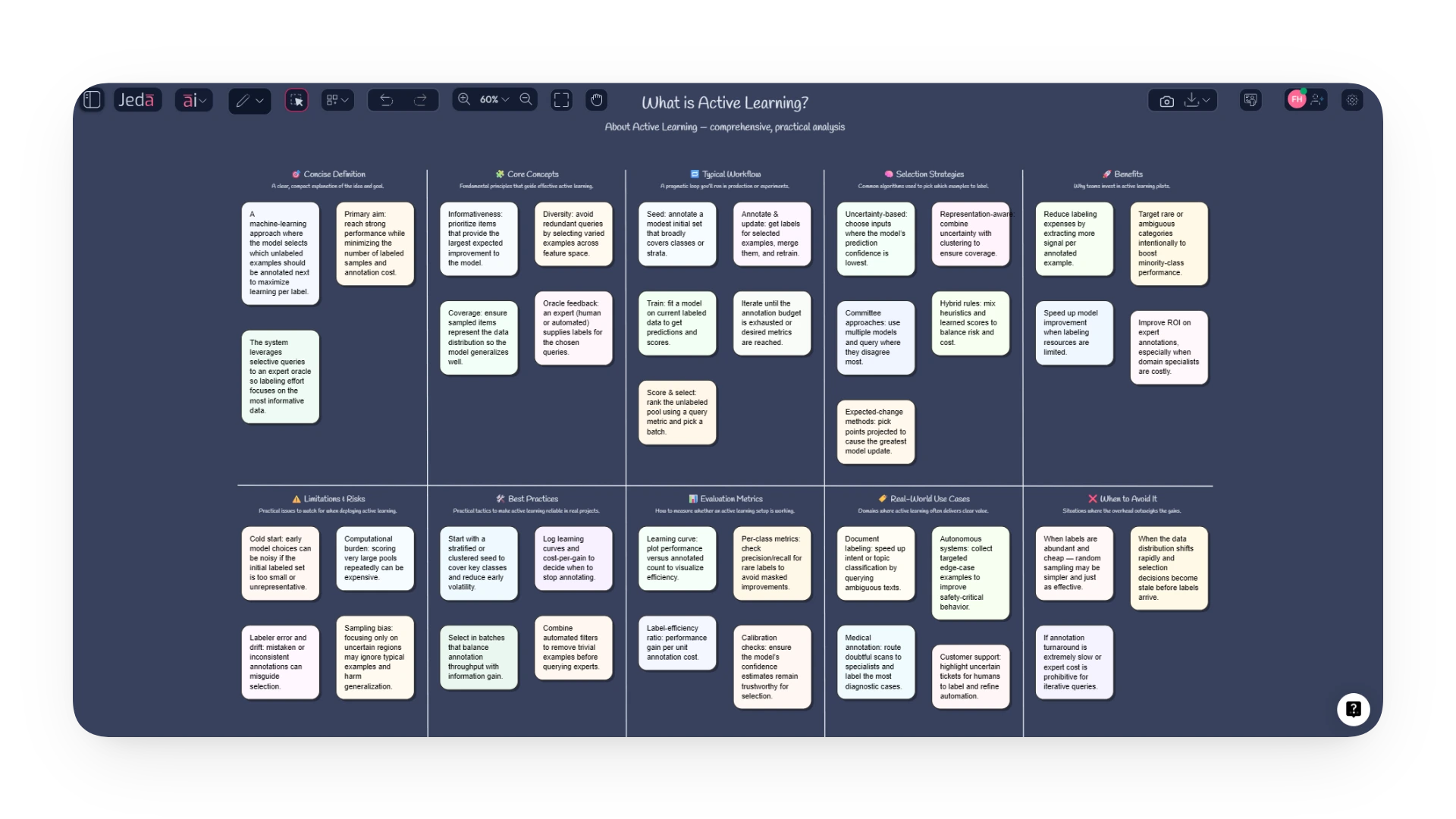
Active learning encourages students to interact with lecture content rather than just listen. For MBA students, this involves case discussions, problem-solving exercises, and real-world applications of theoretical frameworks. Students analyze, debate, and build actionable insights instead of passively consuming slides.
Active learning enhances retention and helps learners connect theory to practice. Techniques include group brainstorming, peer reviews, role-playing, and interactive exercises. By engaging in these activities, students develop critical thinking, analytical, and leadership skills essential for MBA success.
Why Is It So Hard to Keep Students Engaged?
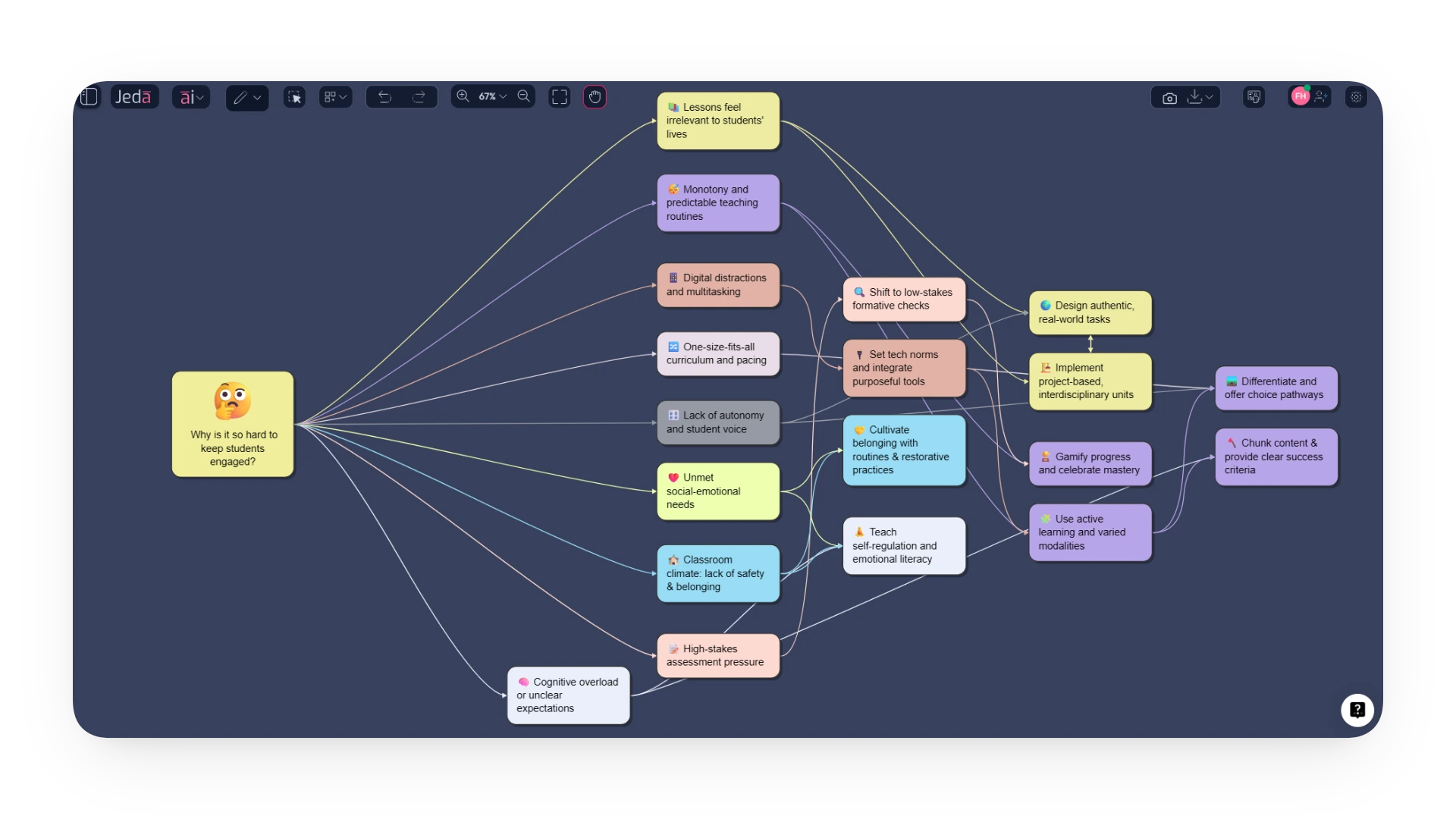
Maintaining student engagement in MBA classrooms is challenging due to dense content, long lectures, and passive learning methods like slides and PDFs. Diverse learning styles, heavy workloads, and limited interaction further contribute to disengagement, making it essential to adopt tools and strategies that foster active participation.
Keeping MBA students engaged can be challenging due to -
• Information overload: Dense readings and lengthy lectures can overwhelm learners.
• Distractions: Smartphones, multitasking, and online environments can reduce focus.
• Diverse backgrounds: Cohorts vary in experience, making uniform engagement difficult.
• Traditional lecture formats: Passive note-taking often fails to stimulate thinking.
Maintaining interest requires active participation and interactive learning methods, encouraging learners to take ownership of their education.
How Does Tech Combat Classroom Boredom?
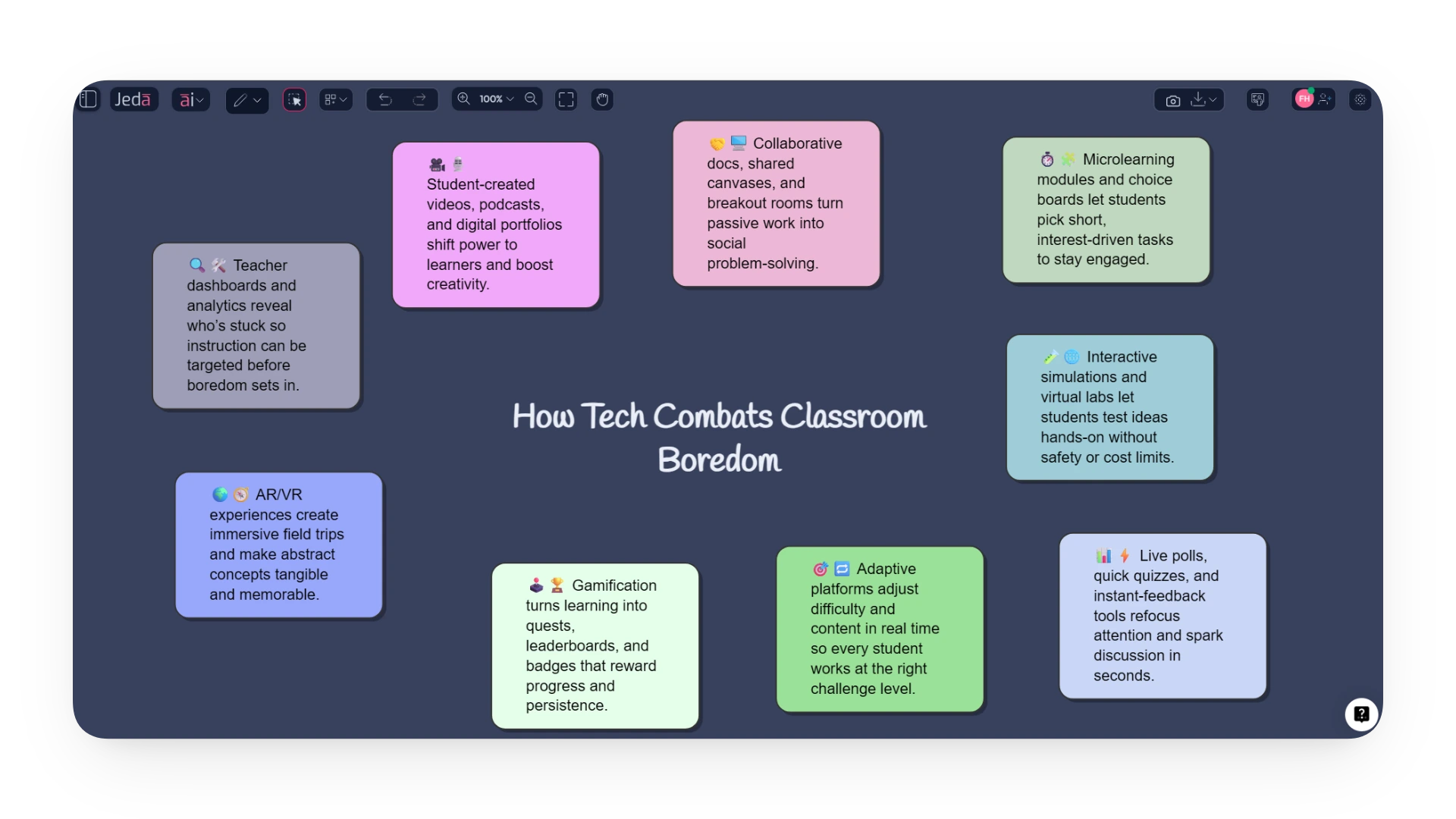
Technology combats boredom by transforming static lessons into interactive experiences. Visual learning, AI-driven analytics, and collaborative tools allow students to interact with case studies, analyze data, and create visual outputs in real time.
Features like mind mapping, flowcharts, and real-time dashboards make learning tangible. By converting readings, slides, and lecture notes into visual frameworks, technology keeps students engaged while fostering creativity, discussion, and critical thinking.
How to Make the Most Out of Your Teaching Tech?
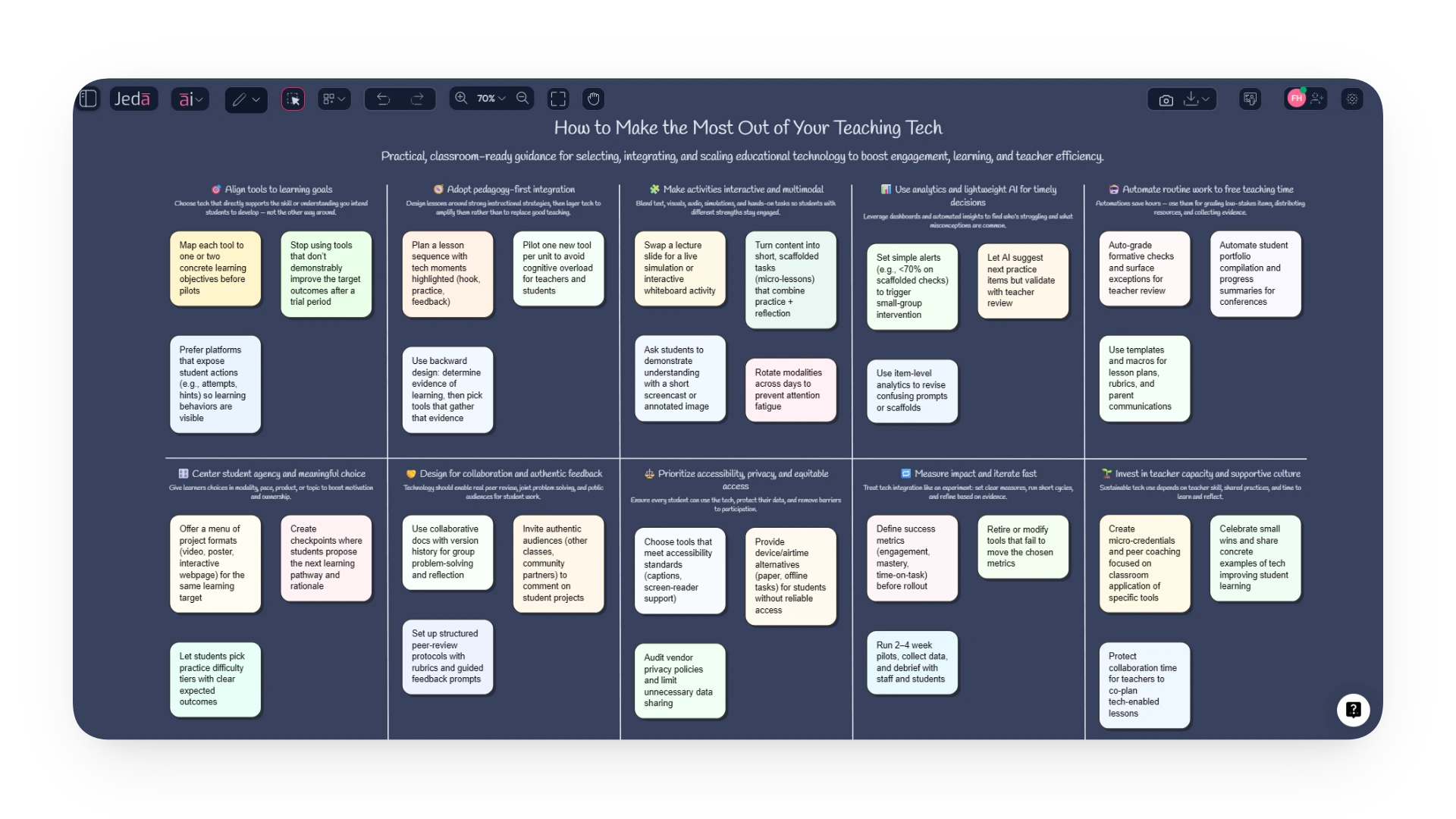
Maximizing teaching technology requires thoughtful integration into lesson plans. Instructors should select tools that align with learning objectives, encourage active participation, and simplify complex content. Combining interactive visuals, AI-driven analytics, and collaborative platforms ensures students remain engaged, while educators can efficiently track progress and enhance learning outcomes.
To maximize teaching tech:
1. Select tools aligned with learning objectives.
2. Incorporate visuals to simplify complex concepts.
3. Encourage collaboration through shared workspaces.
4. Optimizing routine tasks like note-taking, slide creation, and document summarization.
5. Track participation and engagement to adjust teaching strategies in real time.
Effective use of technology ensures active learning, better comprehension, and more efficient classroom management.
What Are Different Types of Engagement Tools for the Classroom?
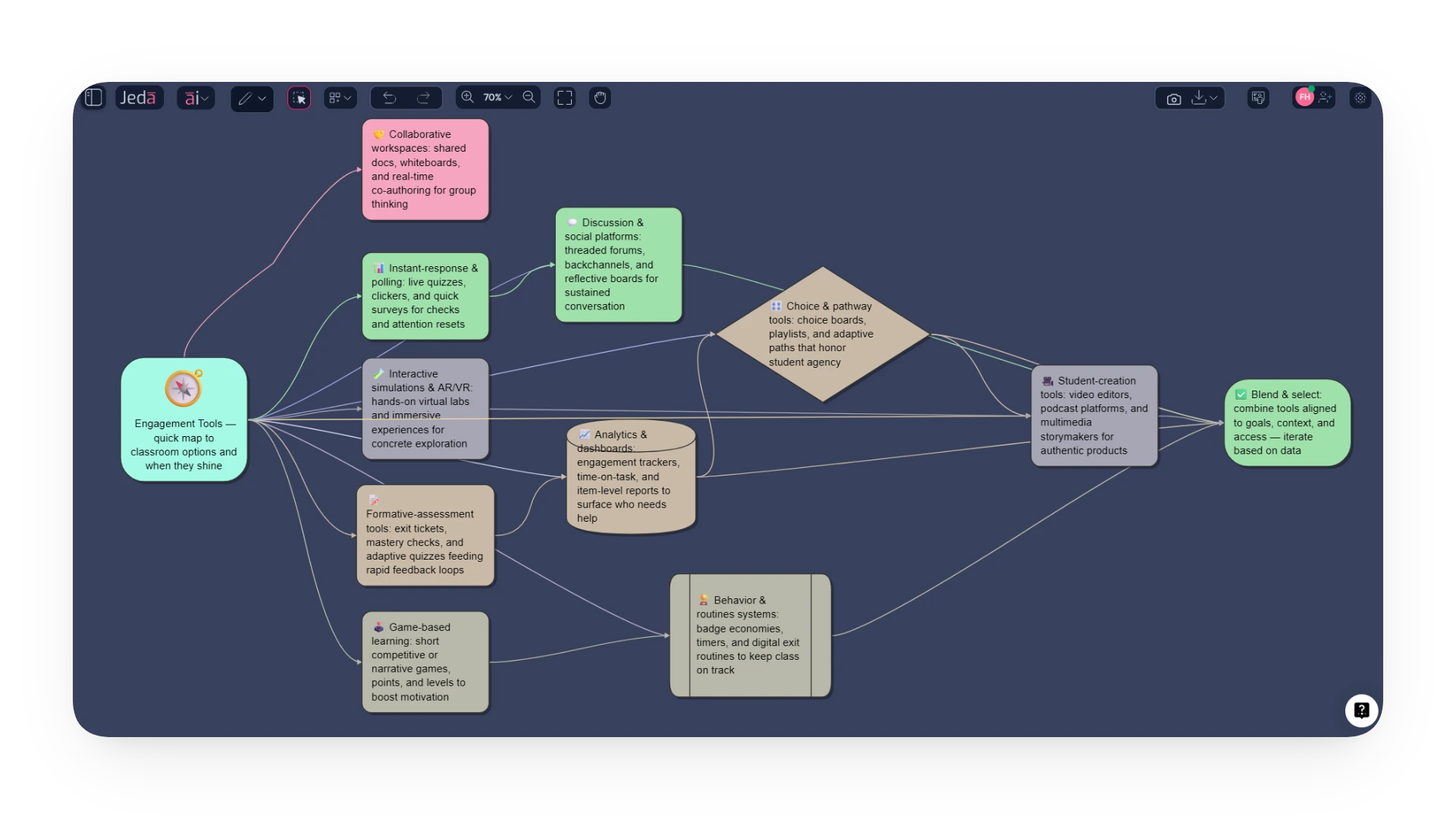
Classroom engagement tools come in various forms, including interactive online whiteboards, AI-driven learning platforms, real-time polling apps, collaborative mind maps, and gamified quizzes. These tools encourage participation, facilitate visual learning, and help students apply concepts actively, making lessons more dynamic, memorable, and impactful.
Engagement tools include:
• Visual Whiteboards: Mind maps, diagrams, and flowcharts for conceptual clarity.
• Collaborative Dashboards: Real-time co-creation and discussion.
• Sticky Notes and Brainstorming Boards: Capture spontaneous ideas.
• Infographic Creators: Transform discussions and research into visual summaries.
• AI Content Generators: Summarize cases, create briefs, and generate insights self-operating.
Each tool promotes active participation, better retention, and collaborative learning, ensuring students are more than passive listeners.
What Are the Best Practices of Using Student Engagement Tools in the Classroom?
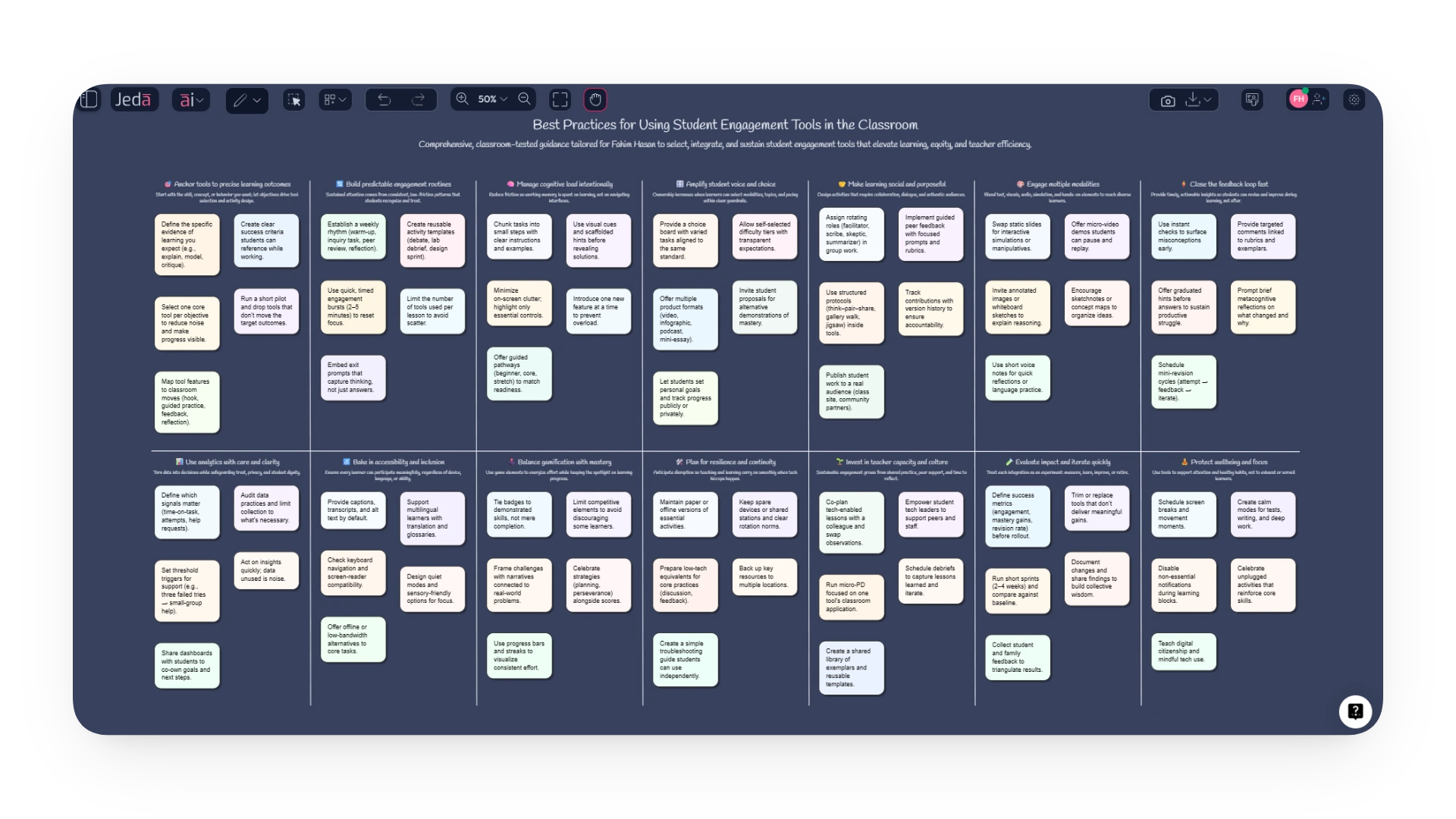
To maximize the impact of engagement tools, instructors should align technology with learning objectives, encourage active participation, provide clear guidance, and monitor progress. Combining interactive visuals, AI-powered insights, and collaborative exercises ensures students remain focused, engaged, and able to apply concepts effectively.
1. Integrate consistently: Use tools for prep, in-class engagement, and post-class review.
2. Combine visuals with collaboration: Encourage co-creation of mind maps, diagrams, and frameworks.
3. Encourage student input: Let learners contribute to frameworks and annotations.
4. Use AI for analysis: Computerize document summarization and strategy visualization.
5. Blend AI insights with teaching guidance: Use human facilitation to contextualize AI outputs.
Best practices ensure that tools enhance learning instead of distracting, keeping engagement high and improving outcomes. Done correctly, the use of AI Tools for MBA Students enhances outcomes without overwhelming the classroom experience.
How Jeda.ai Can Help EMBA Students
EMBA programs are designed to push students to their intellectual limits. From analyzing intricate case studies to navigating complex business strategies, EMBA students face a whirlwind of readings, collaborative exercises, and high-stakes projects. Traditionally, they rely on static slides, lengthy PDFs, and isolated note-taking tools. While functional, these methods often fall short of fostering active engagement, creative problem-solving, or efficient collaboration. This is exactly where AI tools for MBA students, such as Jeda.ai, play a transformative role. Jeda.ai is an AI-powered platform that enhances EMBA learning by integrating visual intelligence, multi-LLM analysis, and real-time collaboration into a single, cohesive workspace.
Imagine an EMBA cohort tackling a global market entry strategy. With conventional tools, students would scramble between PDFs, spreadsheets, and PowerPoint slides, trying to map relationships, risks, and outcomes manually - often resulting in fragmented thinking and lost momentum. By contrast, AI Tools for MBA Students like Jeda.ai eliminate this friction entirely. Its Visual AI Canvas centralizes all inputs - lecture notes, case documents, and datasets - into a dynamic, interactive environment. Students can see mind maps, flowcharts, and infographics form in real time, turning abstract concepts into tangible, actionable visuals. By engaging with material actively rather than passively, learners retain insights more effectively and develop the strategic thinking skills critical to executive leadership.
Transforming Case Studies Into Interactive Learning
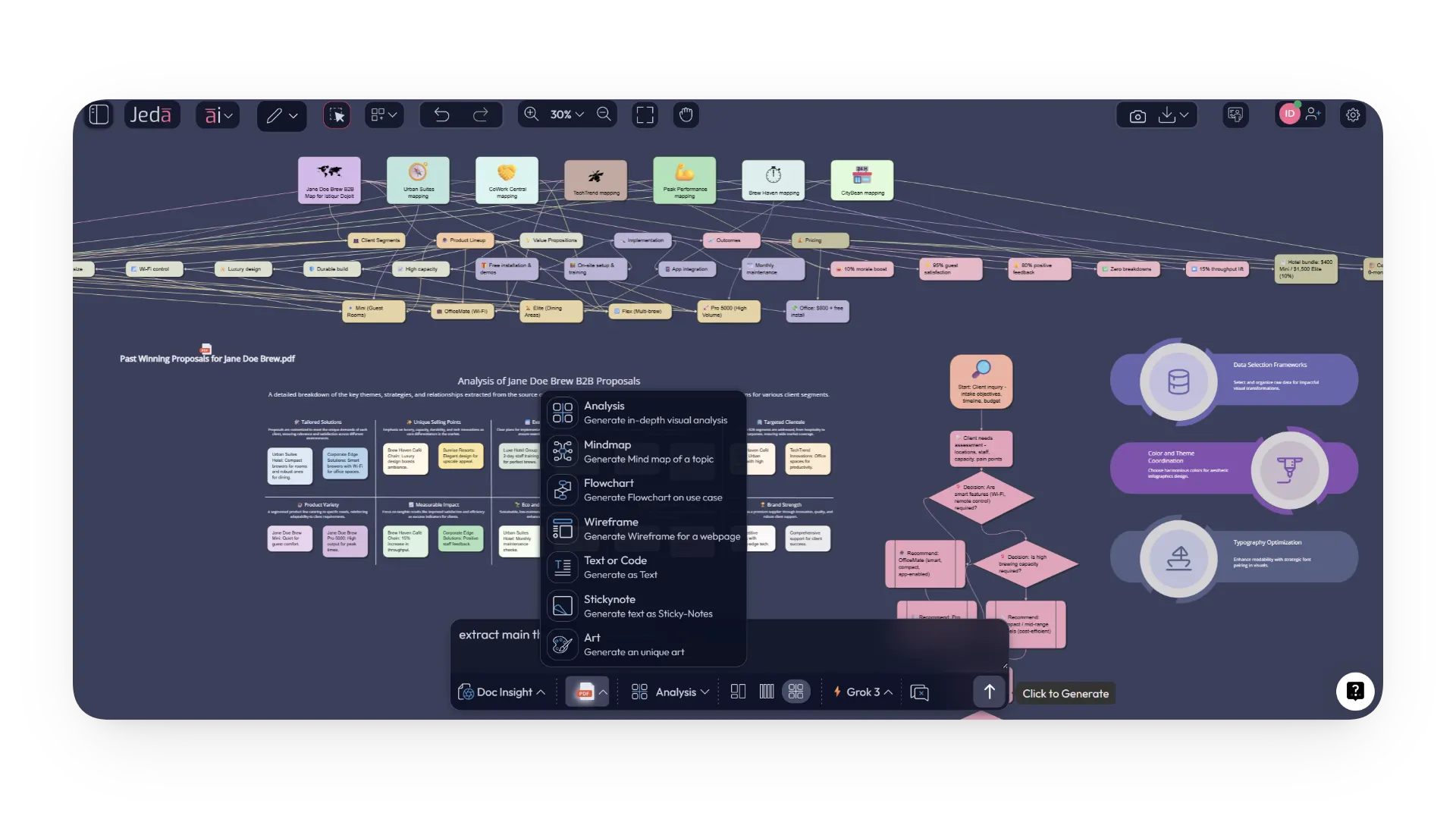
One of the most powerful applications of Jeda.ai is in turning dense case studies into interactive, visually driven learning experiences. Consider a case exploring a merger between two multinational corporations. Traditionally, students would highlight key points in PDFs, jot notes on spreadsheets, and attempt to draw relationships on whiteboards. With Jeda.ai, the AI robotizing converts the text into SWOT analyses, decision timelines, and stakeholder maps.
Students can annotate these visuals collaboratively, test “what-if” scenarios, and see real-time updates as the discussion evolves. For example, if the class considers a new regulatory risk, Jeda.ai instantly updates the risk map, showing the cascading effect on timelines, stakeholders, and financial projections. This visual, iterative approach not only accelerates comprehension but also cultivates critical thinking, as students see the interconnected consequences of strategic decisions immediately.
Multi-LLM Intelligence for Smarter Insights
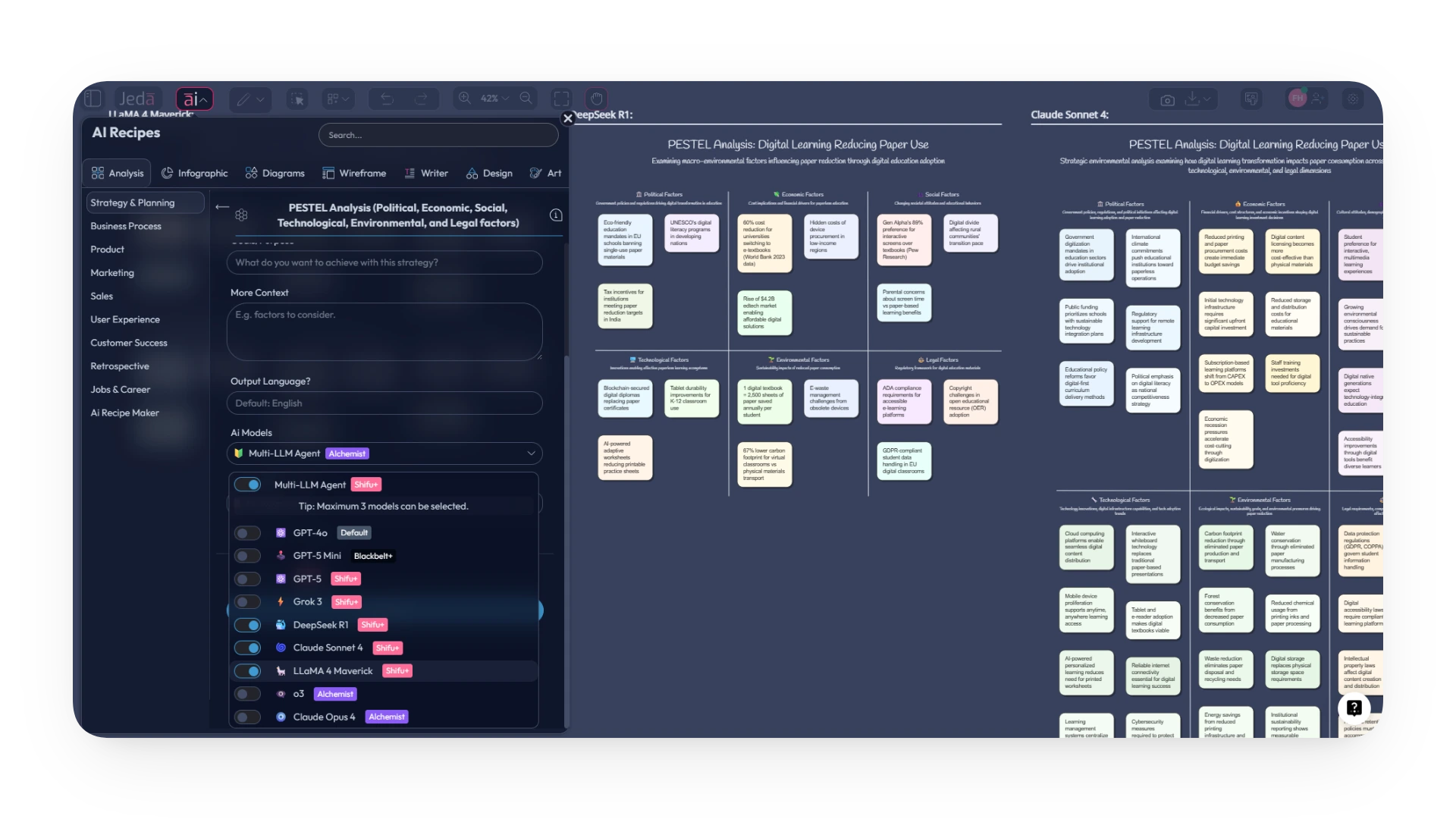
Jeda.ai stands apart with its multi-LLM architecture, integrating models like GPT-5, Opus & Sonnet, DeepSeek R1, Grok, and more. Each model brings unique analytical strengths, enabling the AI to synthesize complex inputs into meaningful outputs.
For EMBA students, this translates into:
• Instant strategic frameworks: Uploaded case PDFs become editable SWOTs, BCG matrices, or PESTEL charts.
• Data-backed recommendations: Financial models or operational scenarios are Systematizing visualized with actionable insights.
• Collaborative refinement: Students can edit AI-generated visuals together, refining interpretations as a team.
This multi-model intelligence ensures that outputs are not only accurate but also nuanced, reflecting multiple perspectives, just like an EMBA classroom discussion would demand.
Dynamic Mind Mapping and Flowcharts
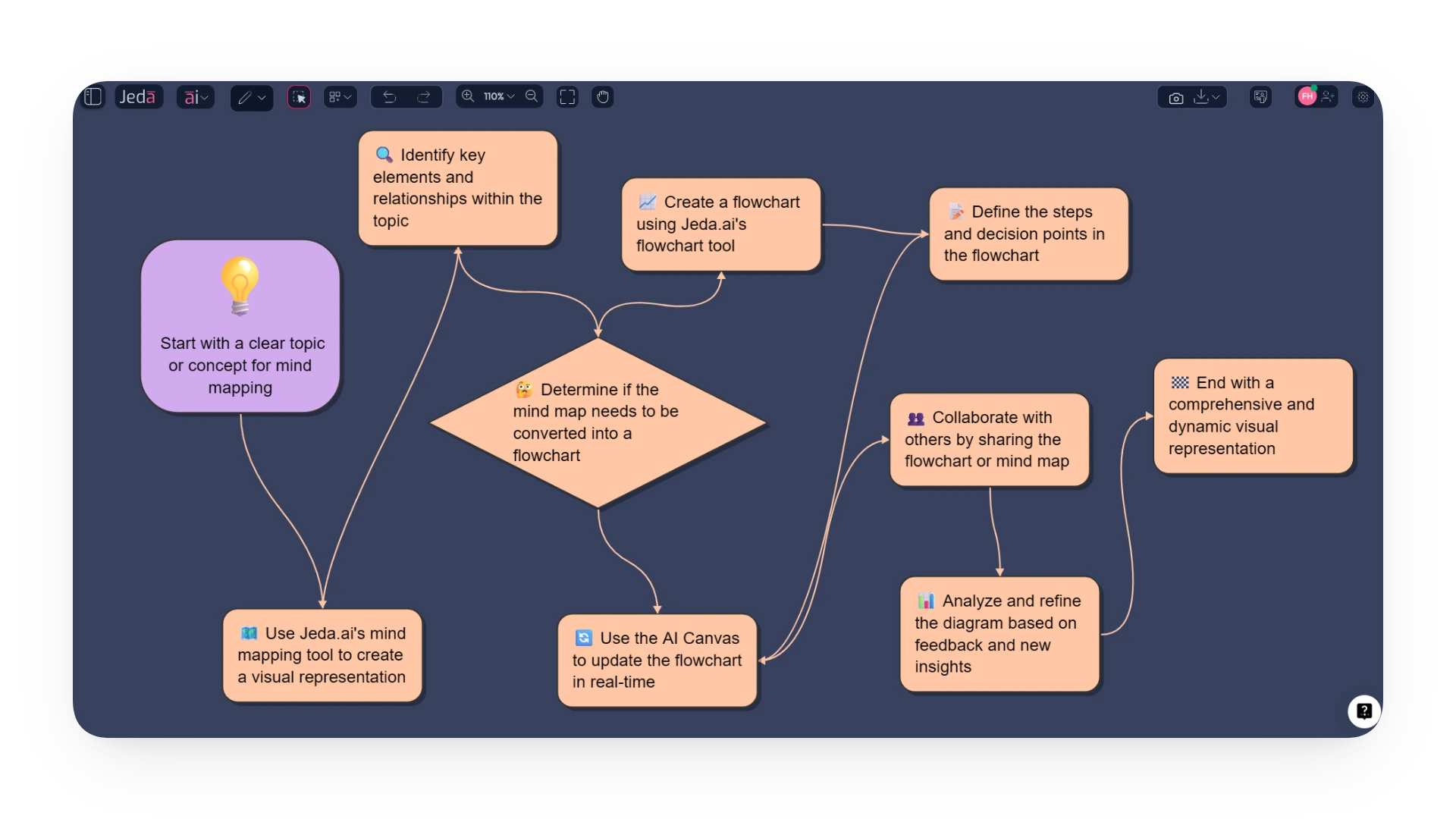
The ability to visualize complexity is central to executive education. Jeda.ai’s mind mapping and flowchart tools allow students to transform raw inputs into dynamic, interactive diagrams. Imagine a lecture on competitive strategy: as the instructor explains Porter’s Five Forces, the AI Canvas updates with added context, connecting suppliers, competitors, and market dynamics with live annotations from students.
Unlike static slides, these diagrams evolve with discussion, encouraging students to test assumptions and explore alternative scenarios. The AI Robotizing adjusts for new insights, ensuring that learning remains fluid and responsive. This method is particularly effective for global strategy, operations management, and financial risk analysis, where multiple variables interact in complex ways.
Creativity and Design Thinking in Action
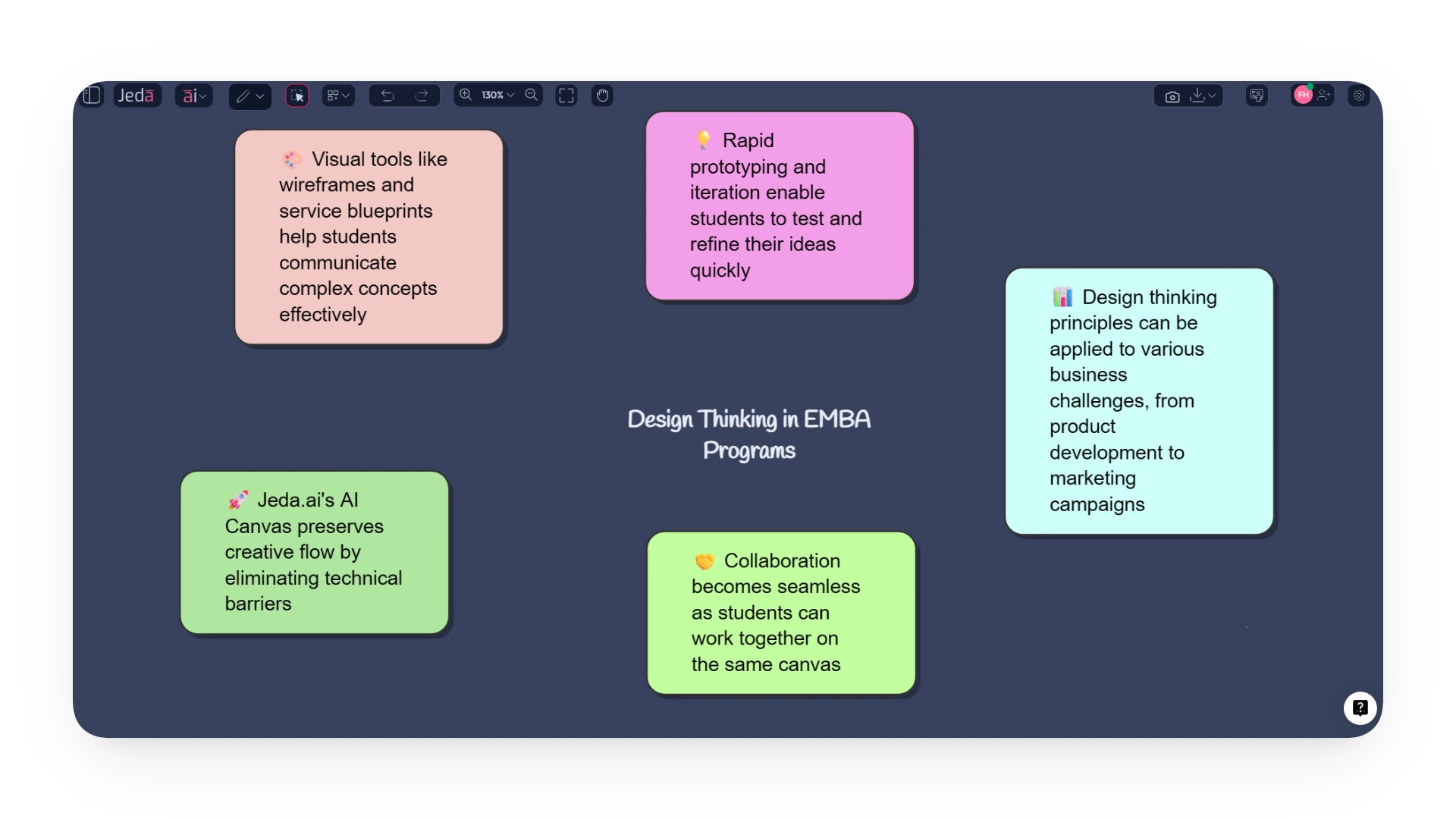
Modern EMBA programs increasingly emphasize innovation and design-led thinking. Jeda.ai supports this by enabling students to sketch wireframes, mockups, and service blueprints directly on the canvas. Even rough doodles or screenshots can be transformed into polished, professional visuals, preserving creative intent while providing clarity.
Whether students are mapping customer journeys, designing new product concepts, or planning marketing campaigns, the Visual AI Canvas allows rapid iteration without technical bottlenecks. Traditional tools often require switching between apps or manual redraws, breaking the creative flow. With Jeda.ai, students remain immersed in the ideation process, accelerating learning and fostering innovation.
Real-Time Collaboration Across Cohorts
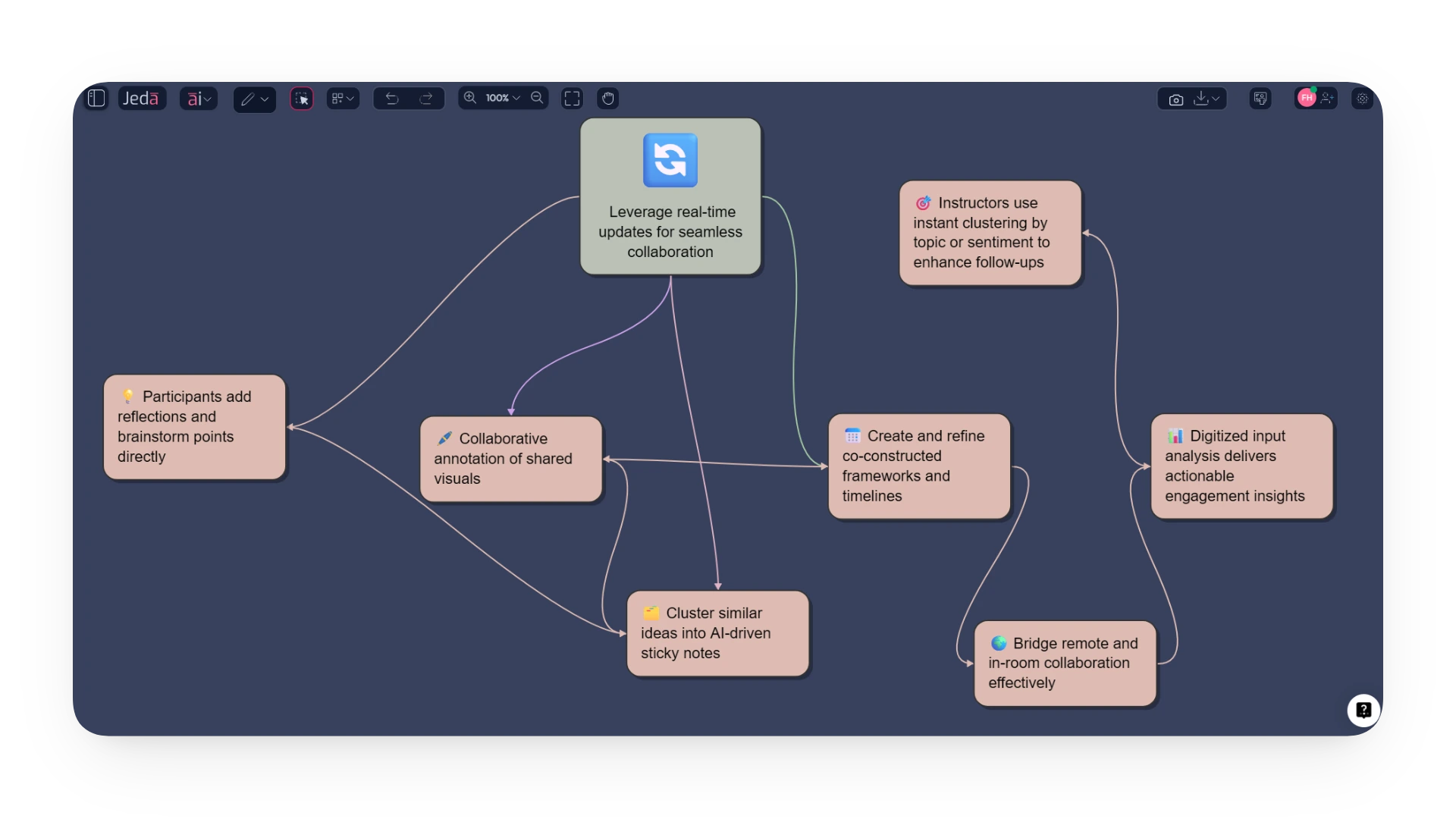
EMBA cohorts often include professionals scattered across multiple locations. Jeda.ai’s real-time collaborative AI Whiteboard ensures that all participants, whether in-room or remote, see the same updates instantly. Students can:
• Drop reflections and brainstorming points
• Cluster ideas using AI-driven sticky notes
• Annotate visuals collaboratively
• Co-create timelines and strategic frameworks
This capability bridges geographical gaps and encourages active participation, ensuring that group exercises are productive and inclusive. For instructors, Digitizing clustering of student input by topic or sentiment provides instant insights into engagement and comprehension, making follow-ups precise and actionable.
From Raw Data to Actionable Insights

EMBA students are constantly tasked with turning theory into actionable decisions. Jeda.ai excels here, transforming raw data, case study variables, and lecture notes into heatmaps, decision timelines, and interactive strategies. For instance:
• A marketing case dataset can be visualized as a customer segment heatmap.
• Operational decisions can appear as flowcharts highlighting trade-offs and dependencies.
• Product Requirements Templates with AI Recipes.
Beyond visualization, Jeda.ai enables executive-grade outputs, including polished memoranda, one-pagers, or presentation-ready reports. The AI refines tone, structure, and style, saving students countless hours of manual editing.
Hybrid Learning and Multimodal Integration
EMBA programs frequently combine in-person lectures with online modules. Jeda.ai integrates seamlessly with this hybrid structure, enabling students to:
• Collaborate in real time during remote sessions.
• Access pre-class readings transformed into visual summaries.
• Use interactive templates for innovation sprints and group exercises.
By unifying reading, analysis, collaboration, and presentation in a single platform, Jeda.ai minimizes cognitive load, prevents workflow fragmentation, and ensures learning remains focused on critical thinking and strategic application.
Frequently Asked Questions (FAQ)
1. What is Jeda.ai, and how can it help EMBA students?
Jeda.ai is an AI-powered Visual Canvas and multi-LLM workspace designed to enhance learning, collaboration, and strategy creation. For EMBA students, it transforms complex case studies, lecture notes, and datasets into interactive mind maps, flowcharts, and infographics, enabling active engagement, faster comprehension, and executive-level output creation.
2. How does Jeda.ai promote active learning?
By converting static content into interactive visuals, Jeda.ai encourages students to co-create frameworks, brainstorm ideas, and participate in live discussions. This hands-on approach shifts learning from passive note-taking to active problem-solving.
3. Can Jeda.ai handle hybrid or remote learning environments?
Absolutely. Jeda.ai’s real-time collaborative AI Whiteboard allows in-room and remote students to contribute simultaneously. Updates are reflected instantly, ensuring cohesive teamwork across locations and time zones.
4. What types of visuals can Jeda.ai generate for EMBA courses?
Students can create:
• Mind maps and decision trees
• Any kind of strategic templates like SWOT, BCG, and PESTEL analyses
• PUGH metrix, Heatmaps and timelines
• Project plans, Duncker diagrams, and OKRs
• Infographics and executive summaries
• Wireframes, mockups, and brand visuals
5. How does multi-LLM integration enhance learning?
Jeda.ai uses multiple foundation models like GPT-5, Grok & Sonnet, DeepSeek R1, and more to analyze content from multiple perspectives, generating richer, more nuanced insights for strategy, analytics, and decision-making exercises.
6. Can Jeda.ai help with complex case analysis?
Yes. Upload a case PDF or dataset, and Jeda.ai Streamlining generates visual frameworks, annotated timelines, and stakeholder maps, allowing students to analyze risks, trade-offs, and strategic outcomes efficiently.
7. Does Jeda.ai assist with creative projects?
Definitely. Jeda.ai supports low-fi wireframing, mockups, and AI-generated art, enabling students to visualize product concepts, marketing campaigns, or service blueprints without switching between multiple tools.
8. How does Jeda.ai improve collaboration in group projects?
The AI Whiteboard centralizes contributions, clusters ideas Computerizing, and allows students to annotate, refine, and debate frameworks in real time, creating a seamless collaborative experience.
9. How does Jeda.ai save time for EMBA students?
By Streamlining document analysis, visual generation, project planning, and executive summary creation, students save hours of manual work. On average, users report faster deliverables, less busywork, and sharper insights.
10. Can instructors benefit from Jeda.ai too?
Absolutely. Instructors can prepare lessons, visualize frameworks, track engagement, and manage follow-ups all on one platform, allowing them to focus on teaching rather than administrative tasks.
11. How does Jeda.ai foster executive-level skills?
Through its interactive, AI-driven workspace, students develop strategic thinking, data-driven decision-making, leadership, and professional communication skills, preparing them to lead organizations effectively.
Wrapping Up
For EMBA students, Jeda.ai is not merely a productivity tool, it is a comprehensive learning ecosystem. By combining multi-LLM intelligence, real-time collaboration, visual analytics, creative design, and executive-level output capabilities, it transforms the EMBA experience from passive content consumption into active, immersive learning.
Students not only absorb complex concepts faster but also develop essential executive skills, from strategic thinking and data-driven decision-making to collaboration and professional communication. By centralizing workflows, operationalizing visualizations, and facilitating dynamic engagement, Jeda.ai empowers future leaders and proves exactly why AI Tools for MBA Students now define the future of business education.


.png)


%202.svg)