Streamline Your Product Lifecycle Management Template with AI using Jeda.ai's Unified Visual Workspace
The modern Product Lifecycle Management Template with AI is swiftly becoming a core strategic asset for product teams drowning in disconnected apps and manual reporting. If you're constantly wrestling with version control in spreadsheets, recreating diagrams for slide decks, or struggling to unify feedback from different teams, you already know the pain. This article will guide you through a smarter way to unify your entire product strategy, from a spark of an idea to a successful launch, by leveraging intelligent technology.
Most product managers don't have one workspace; they have a dozen. You might brainstorm on a digital whiteboard, track specs in a doc, analyze data in a separate tool, and then spend hours copying, pasting, and reformatting everything into a presentation. This constant context-switching is a massive productivity killer, pulling your focus away from strategic thinking and into manual, repetitive tasks.
The second major headache is fragmentation. Critical customer insights are buried in PDF reports, market data is stuck in a CSV file, and the latest design feedback is in a separate collaboration tool. Without a single source of truth, making confident, data-driven decisions about your product's next phase feels like guesswork. This is exactly why a dynamic Product Lifecycle Management Template with AI is a game-changer.
TL;DR: Your Product Strategy, Simplified
🧩 Ditch the manual grind: Streamline frameworks & slides with a Product Lifecycle Management Template with AI.
🧩 Unify your tools: Replace app-hopping with a single, powerful Agentic AI Whiteboard.
🧩 Accelerate outcomes: Go from idea to client-ready strategy faster than ever with a smart PLM Template with AI.
What is Product Lifecycle Management?
A Product Lifecycle Management Template with AI is built around a core business discipline.
So, what exactly is Product Lifecycle Management (PLM)? In simple terms, it's the systematic process of managing a product's entire journey, from its initial concept and ideation all the way through to its eventual retirement. Think of it as the master blueprint that guides your product from a back-of-the-napkin sketch to a market-ready solution and beyond.
Mapping the Product Journey: The Key Stages
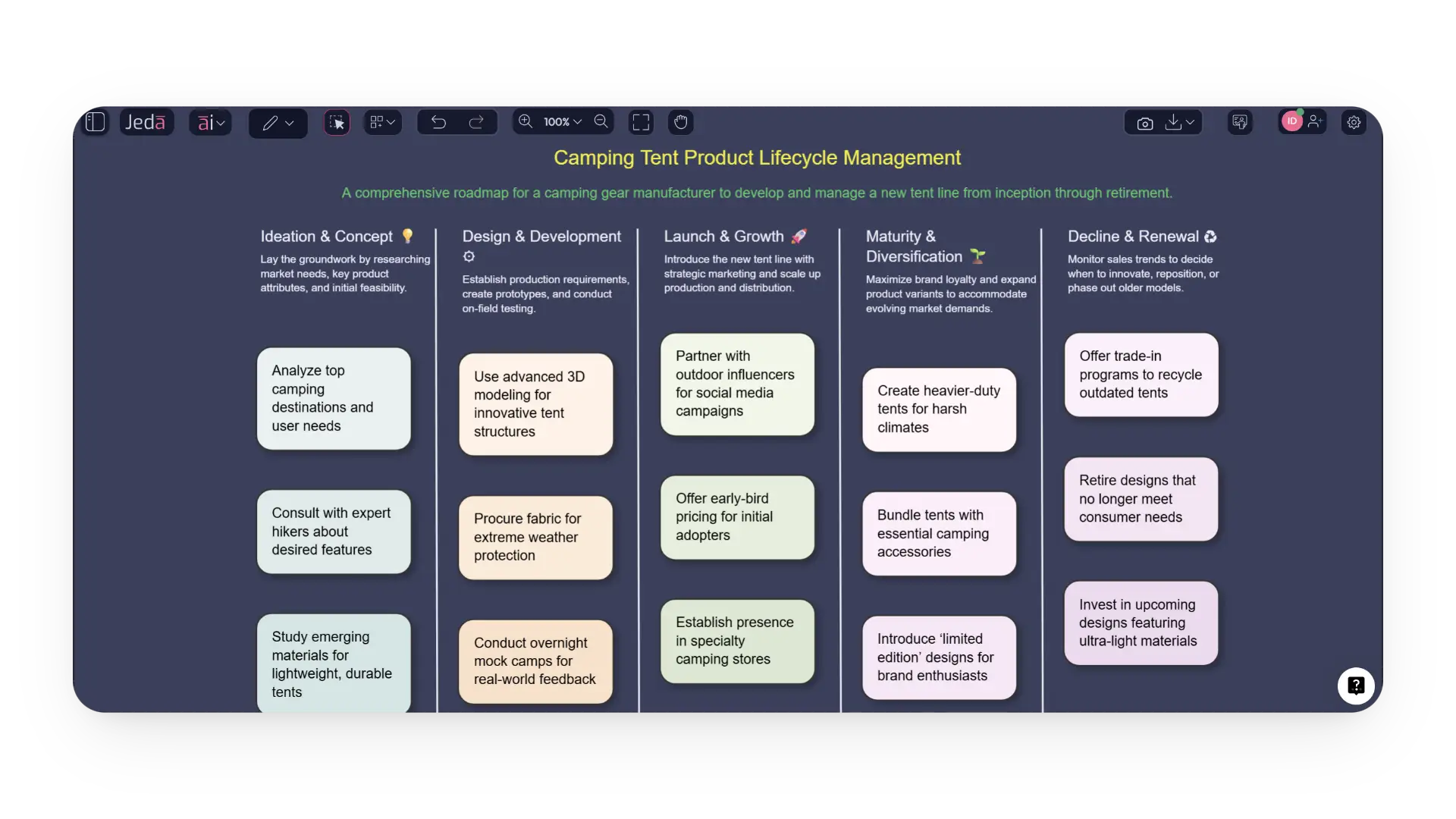
This process typically unfolds across several key product lifecycle stages. It begins with the 'Concept' phase, where ideas are born and validated. It then moves into 'Design,' where those ideas take shape, followed by 'Development and Testing' to refine the product. Finally, it culminates in the 'Launch and Introduction' to the market, followed by ongoing 'Growth, Maturity, and eventually, End-of-Life' management.
Why a Cohesive Strategy Matters
Without a clear framework, this product development process can quickly become chaotic. A cohesive PLM (Product Lifecycle Management) strategy ensures every team, from engineering and marketing to sales and support, is aligned on the same goals and timeline. It brings order to the complex journey from idea to launch, preventing miscommunication and costly missteps. This holistic approach is the foundation that a powerful Product Lifecycle Management (PLM) Template with AI is designed to support and enhance.
The High Cost of Disconnected Product Management
Feeling like a project manager instead of a product visionary? You're not alone. Traditional methods create frustrating roadblocks that drain time and energy.
"I'm a PowerPoint Mechanic, Not a Strategist"
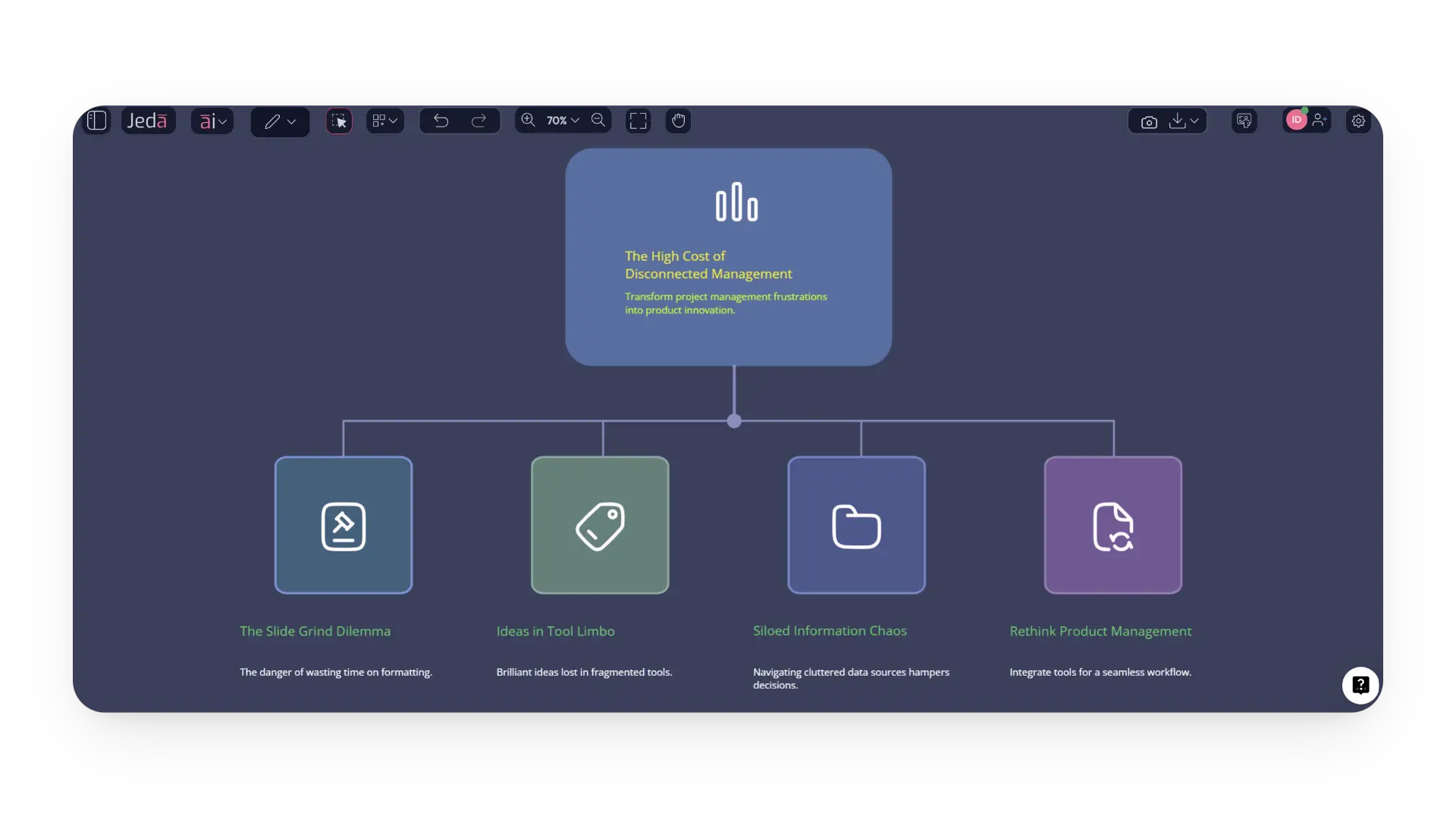
How many hours did you last spend aligning boxes and formatting text? This "slide grind" is the silent killer of innovation. Instead of analyzing market fit, you're manually building SWOT analysis slides from scratch. Your deep strategic work gets buried under tedious, repetitive formatting tasks.
"My Best Ideas Get Stuck in Tool Limbo"
That brilliant flowchart from your brainstorming session? It's now trapped in a screenshot. You face the dreaded "re-draw" phase to make it presentation-ready. This tool-hopping fatigue, constantly switching between whiteboards, docs, and slides, shatters focus and dilutes your original thinking.
"The Truth is Hidden in a Dozen Different Tabs"
Siloed information is your biggest enemy. Critical user feedback lives in support tickets, market data is stuck in a CSV, and the latest specs are in a separate doc. Making a confident decision becomes a guessing game without a single source of truth. This chaos is exactly what a unified Product Lifecycle Management Template with AI is designed to eliminate.
The 5 Stages of Product Lifecycle Management: A Stage-by-Stage Guide
Navigating a product's journey from a spark of an idea to market retirement requires a clear roadmap. Understanding these five core product lifecycle stages is the first step toward mastering your product development process. Let's break down this journey from idea to launch and beyond.
Stage 1: Concept and Ideation
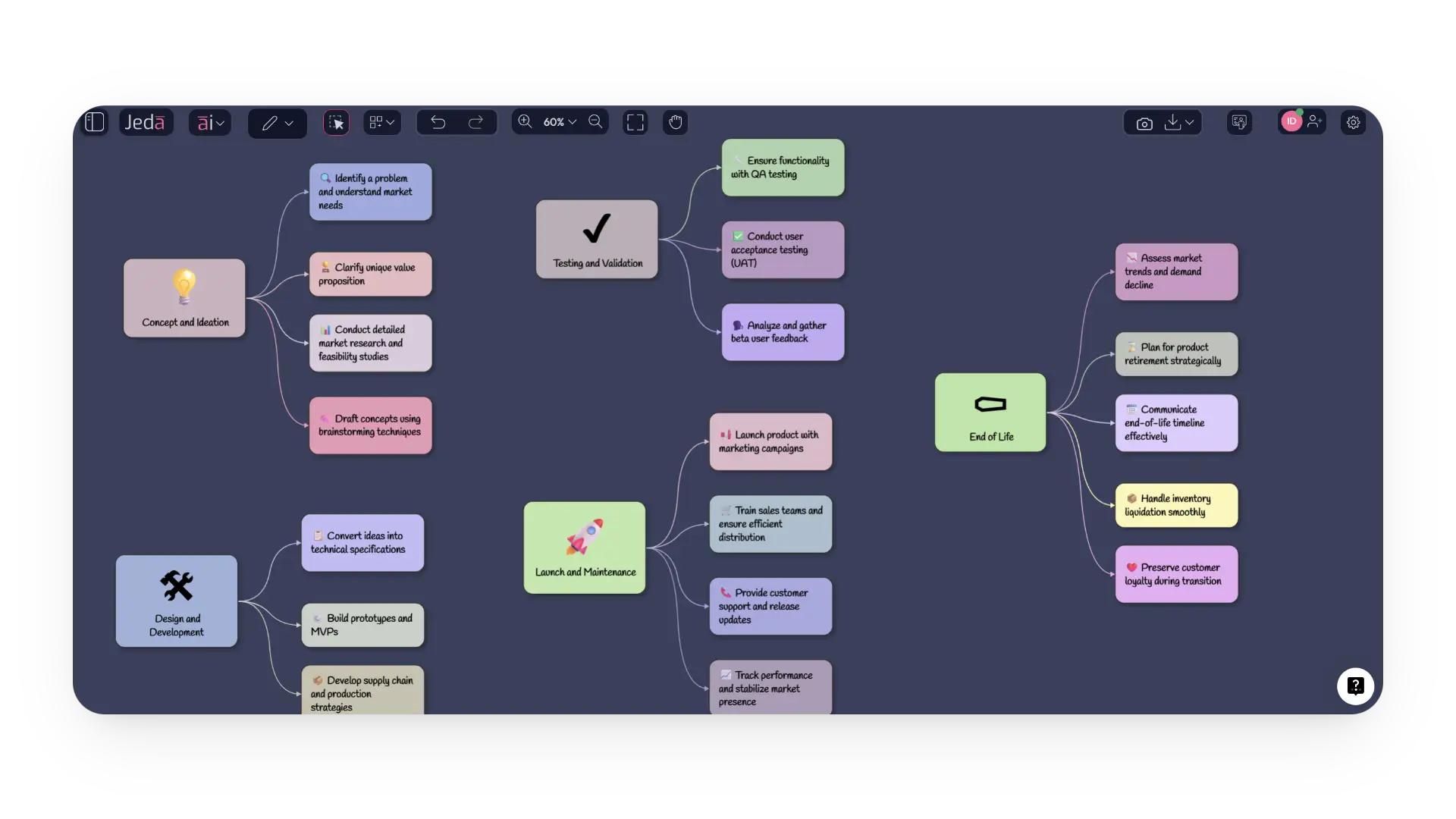
This is where everything begins. The concept ideation phase is all about exploration and validation.
♦️ Key Questions: What problem are we solving? Is there a market need? What is our unique value proposition?
♦️ Common Artifacts: Market research summaries, brainstorming mind maps, initial feasibility studies, and rough business cases.
This stage is crucial for aligning the team on a central vision before significant resources are invested.
Stage 2: Design and Development
Here, abstract ideas start taking a tangible form. The design and development phase turns concepts into detailed plans and prototypes.
♦️ Key Activities: Creating technical specifications, building prototypes, developing the minimum viable product (MVP), and establishing the initial supply chain.
♦️ Team Focus: Engineering, design, and manufacturing collaborate intensely to bring the product blueprint to life, balancing creativity with technical constraints.
Stage 3: Testing and Validation
Before a full-scale launch, you must ensure the product works as intended and resonates with users. This phase is all about de-risking.
♦️ What Happens: Rigorous quality assurance (QA) testing, user acceptance testing (UAT), and gathering feedback from a limited beta audience.
♦️ The Goal: Identify and fix bugs, validate user experience, and confirm that the product meets the defined requirements and market expectations.
Stage 4: Launch and Maintenance
The product is out in the world! This stage involves executing a solid go-to-market strategy and shifting to ongoing support.
♦️ Launch Activities: Marketing campaigns, sales team training, distribution logistics, and public relations.
♦️ Maintenance Mode: Monitoring performance, releasing patches and updates, providing customer support, and managing inventory.
The focus is on growth and stability this time around.
Stage 5: End of Life
All products eventually reach a point of declining demand or outdated technology. Managing product retirement strategically is key.
♦️ Key Decisions: When to stop sales and marketing? How long will support continue? What is the migration path for existing customers?
♦️ The Process: Communicating the timeline to customers, liquidating inventory, and sunsetting support services.
A well-managed exit preserves customer goodwill.
Why This Framework Matters for a Modern Team
A disjointed approach to these stages creates chaos. When your concept ideation is in one app, design development in another, and your go-to-market strategy scattered across emails and slides, you lose the strategic thread. This fragmentation is why a cohesive Product Lifecycle Management Template with AI is so powerful; it unifies this entire journey, ensuring every stage connects seamlessly to the next.
Why Traditional Tools Can't Fix the Core Problem
Adopting a Product Lifecycle Management Template with AI highlights a fundamental flaw in the old way of working. The core issue isn't the individual tools themselves, but the fractured ecosystem they create.

The Vicious Cycle of App-Switching
You might use one app for brainstorming, another for documentation, and a third for presentations. This constant shuffling creates severe tool fatigue. Each switch costs you focus and momentum, breaking your strategic flow and burying insights in a maze of tabs and logins.
The Intelligence Gap in Your Workflow
Traditional templates are static. They can't connect the dots between a customer feedback PDF, a financial spreadsheet, and your project timeline. They lack the native intelligence to synthesize data or suggest strategic connections, leaving you to do the heavy lifting. This is the exact gap a dynamic Product Lifecycle Management Template with AI is built to fill.
The AI-Augmented Advantage in Product Lifecycle Management
Imagine a Product Lifecycle Management Template with AI that works alongside you as a strategic partner. This isn't about automation replacing your expertise; it's about having a powerful AI co-pilot that handles the tedious work, freeing you to focus on high-level strategy and innovation. This is the core of the modern AI Workspace.

From Static Templates to Dynamic, AI-Generated Frameworks
Stop manually building frameworks from a blank slate. The power of visual AI transforms this process.
🪄 Example: Instead of drafting a SWOT analysis alone, you can prompt the system with a product concept. The AI can instantly generate a structured, initial SWOT grid by drawing from your market data CSV and your notes.
🪄 The Shift: You move from being a creator of structure to a refiner of insight, turning hours of work into moments of validation for strategies like PESTEL or Go-to-Market plans.
Unifying Vision, Data, and Narrative on One Canvas
The real magic happens when you break down data silos. A multimodal AI can reason across different types of information natively.
🪄 How it Works: This technology acts as your Artificial Intelligence Hub, allowing you to upload a spreadsheet for visual analysis, a PDF report, and a sketch of a user flow. It can find connections between them, synthesizing a unified narrative directly on a Visual AI Canvas.
🪄 The Result: You achieve truly data-driven decisions because all your information lives and interacts in a single All-in-One AI Workspace Canvas, eliminating the friction of multiple disconnected tools. This cohesive environment is the ultimate benefit of a sophisticated Product Lifecycle Management Template with AI.
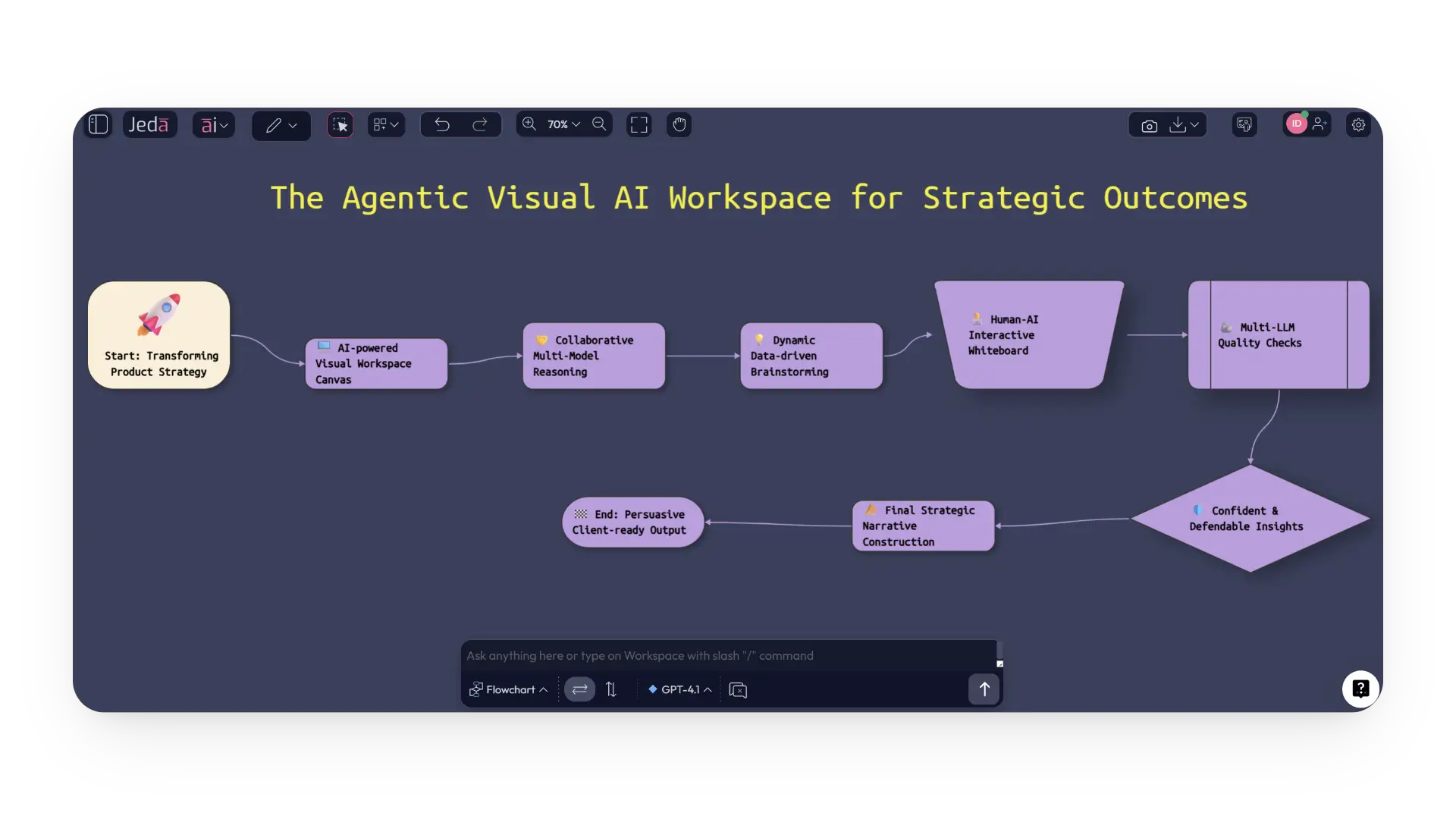
The Agentic Visual AI Workspace for Strategic Outcomes
Imagine a Product Lifecycle Management Template generated by AI that lives on a dynamic canvas, not in a static document. Jeda.ai is precisely that - an Agentic AI Workspace designed to think with you, transforming how teams orchestrate their product strategy from a single, unified Visual AI Canvas.
Your All-in-One Strategic Command Center
Why juggle ten different tabs? Jeda.ai replaces your entire toolstack with one powerful AI Workspace. This All-in-One AI Workspace Canvas erases the friction of app-switching, letting you brainstorm, analyze data, and build presentations without ever losing your train of thought or your strategic narrative.
Where AI Acts as Your Co-Pilot
This is more than a digital whiteboard; it's a Collaborative AI Whiteboard powered by multi-model AI. It actively reasons across your documents and data, helping you refine ideas and cross-check logic in real-time. This collaborative intelligence is the core of a modern Product Lifecycle Management Template with AI.
Why a Jeda.ai Product Lifecycle Management Template is Different
So, what makes a Product Lifecycle Management Template with Jeda AI stand out? It’s designed not just to be a tool, but a strategic partner that amplifies your expertise, directly addressing the core frustrations of modern product leaders and consultants.
Built to Augment, Not to Replace
In an age of AI anxiety, Jeda.ai serves as your co-pilot, not your replacement.
You retain full control over strategic judgment, client nuance, and the final narrative. The platform streamlines the tedious, time-consuming work like formatting complex diagrams or building presentation slides from scratch, freeing you to focus on what truly matters: deep analysis and persuasive storytelling. This Human-AI Interactive Whiteboard ensures you stay in the driver's seat.
Multi-Model Reasoning for Defendable Insights
How do you build confidence in your first draft? Jeda.ai leverages a multi-LLM approach, creating a virtual team of AI models that work in concert. Imagine one model structuring your Go-to-Market outline, while another simultaneously stress-tests the logic and a third refines the language. This built-in AI validation acts like an internal quality check, cross-checking logic to ensure your strategic plans are robust and well-reasoned before they ever face a client review. This powerful Visual Generative AI hub is what makes our dynamic PLM Template with AI a game-changer for confident, strategic planning.

How to Generate Your Product Lifecycle Management Template with AI in Jeda.ai
Getting started with your dynamic Product Lifecycle Management Template with AI is straightforward. Here’s a quick guide to transforming your process on our Agentic AI Whiteboard.
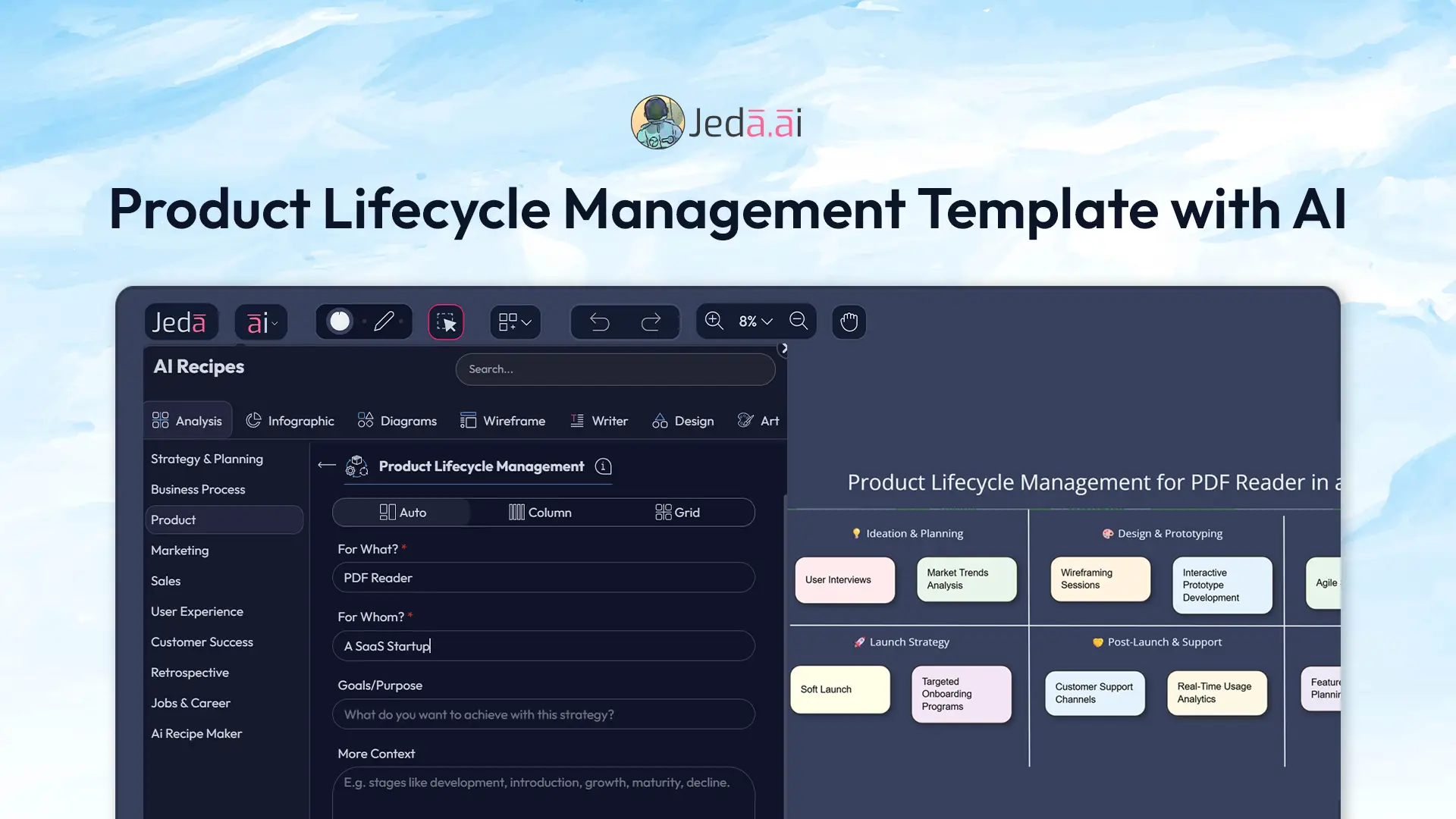
Generate PLM Templates with AI Recipes
✨ Log in to Jeda.ai and enter an AI workspace of your choice.
✨ Navigate to the AI Menu located at the top left corner. Under Product, select the option for the Product Lifecycle Management.
✨ Respond to a few intuitive questions related to your business or project.
✨ Choose your preferred layout and AI model(s).
✨ You may upload and select your project/product specific data or doc files.
✨ Hit “Generate”.
Generate Product Lifecycle Management Template with AI Prompt Bar using Jeda.ai’s Visual AI Workspace
⭐ Enter your desired Jeda.ai Workspace.
⭐ Towards the bottom of your Workspace, you'll see the AI Prompt Bar. Click on it and select the "Analysis" command. Then type in your required query about the Product Lifecycle Management template.
⭐ You may kickstart your brainstorming process with a wealth of prepopulated dynamic prompts provided by the AI.
⭐ When you're satisfied with your prompts and parameters, all you have to do is choose a preferred layout, select one or more AI models and hit the "Generate" button.

Key Considerations When Adopting an AI PLM Template
Implementing a Product Lifecycle Management Template with AI successfully requires a thoughtful approach. To maximize its value, keep a few key principles in mind for a smooth integration into your workflow.
Prioritize Clean, Quality Inputs
The insights you get are only as good as the data you provide. Ensuring good data quality like organized spreadsheets and clear project briefs helps the AI generate more accurate and relevant frameworks and analysis for your strategic planning.
Keep a Human in the Loop
This technology is a partner, not a replacement. A successful human in the loop approach means you use AI-generated drafts as a powerful starting point, applying your own expertise and client context to refine and validate the final strategic output.
Focus on Refinement, Not Just Generation
The real power isn't in the first draft, but in the iterative improvement. View the initial output as a scaffold. Your primary role shifts from building from scratch to strategically editing, enhancing, and applying critical judgment - core AI best practices. This collaborative process is the true strength of a modern Product Lifecycle Management Template with AI.
Wrapping Up
Embracing a dynamic Product Lifecycle Management Template with AI is the key to replacing chaotic workflows with streamlined clarity. This approach fundamentally upgrades how teams orchestrate a product's journey from concept to retirement.
Move beyond scattered tools and manual formatting. An Agentic AI Workspace unifies your entire process onto a single Visual AI Canvas, allowing for seamless collaboration and eliminating the frustrating context switches that drain productivity and focus.
Stop letting manual work and tool-hopping dictate your pace. Reclaim your time for true strategic insight and elevate your team's output with a sophisticated Product Lifecycle Management Template with AI.


.png)


%202.svg)